::Birth Day::

Birthday Cake

Another year has come … and gone. I’m on the fifth day of “next year;” it feels good to have a full tank of gas.

That’s what I call it when a Birthday arrives. The month sliding into my natal day typically finds me “running on fumes.” Through the years I’ve observed that I’m usually a little scatterbrained during that time, forget where I put things or what I’m talking about. Yeah, that can happen any time of year, but it becomes a several-times-daily occurrence during February and most of March. My wheels get loose and jangly, and I careen a bit from side to side. Until March twenty-one.

Somehow I picture myself on that auspicious day, jumping out of bed, backlit. Looking good in spandex. Doesn’t happen quite that way.

This year I spent the entire day in my robe and slippers. It’s a fairly new robe, quite cozy, and the weather was spitting snow in the morning, freezing cold, so … it seemed a good choice. And I thought a lot that day about life, and Birthdays, and what they are. What they mean.

I know some people don’t think Birthdays are a big deal. But I love celebrating other people’s Birthdays. I’m responding to the day they arrived on the planet. I’m saying, “I am cheering that you were born, and that you’re in my life. And every year, on this day, I get to say ‘YAY’ to you!” In this world of automated distance between us all, to me that’s more important than ever.

I saw a story the other day about a man who was celebrating his 105th Birthday. There were people crowded around him as he sat in his chair, wearing his military cap. He was staring at the inferno of a Birthday cake on the table in front of him, and grinning from ear to ear. That man has experienced things I can’t even imagine. He has a lifetime of stories to tell, and I hope there are people he can tell them to. They will be richer for it.

We bear a growing wealth of knowledge, the longer we’re here. None of us know everything. But those of us who pay attention, we know a lot. And much of what we know won’t launch a rocket … but it will settle a fussy child, comfort an old dog, feed a family of eight on one potato and one onion. Plant and tend a garden; use a remedy from that garden to heal a sick one.

It feels good to become “one of those” to whom some turn, seeking comfort, or knowledge, or aid. I have more to give than ever, because I’ve never been here longer than I have today. And with each day that comes, I pray I am open to know more, that I learn new things, and that I have opportunities to share what I know and who I am with any and all who seek it out.

For through wisdom your days will be many, and years will be added to your life. [Proverbs 9:11]

::WHAT SAVES US::

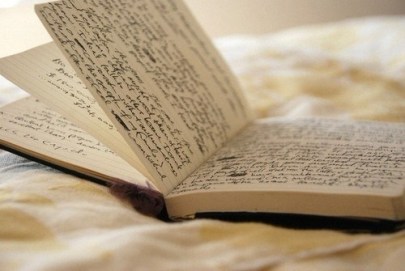
Notebook of Writing


It’s a grey Monday, and I’m ‘working at writing’ in a session with Amy Lyles Wilson, my editor. I say ‘my editor,’ because that sounds very official, doesn’t it? And she is my editor; she’s also a dear, trusted, and longstanding friend. The fact is, I’m not sure how a writer/editor relationship could work otherwise.

It’s a courageous thing, writing. As Hemingway says, ‘There’s nothing to writing; all you do is sit down at a typewriter and bleed.’ That’s the long and the short if it, right there.

The first draft of my book is finished. Yes, I deliberately “buried the lead” here. Because I’m not entirely sure how I feel about it. I’ll tell you this: it was with a weary, a relieved, and an ultimately dispassionate resolve that I finally finished that draft. And I’m a bit nervous about all the soul bearing stuff I wrote down in those 177 pages. I’d like to change my mind about some of it. But that would require a rewriting of my little piece of history. Truth lives on those pages, for better or for worse. Now, all I can do is breathe.

Writing is an excavation of the heart. When it’s about your own life, about how you got to here from there, it is a staunch enterprise. There are days — many — when you’re riddled with the thought that nobody could possibly be interested. Why would they care? Why am I doing this? But you continue on determined to, at the very least, finish what you started.

And so, you do. It might take twenty three years. You might, in 1995, get an official invite-to-submit from a major New York agent and knock yourself out writing enough to send her a sample. You might even get a letter back, saying she loves your work, that it feels “introductory,” and to please send more when your book is further along.

It’s March, 2018. That letter is in my file drawer. Wonder if she’s still interested.

The fact is, we all have stories. Amy’s slugline on her website is, “It’s the sharing of our stories that saves us.” And nothing could be more true. The funny stories, the heartbreaking stories, the stories that, when the readers read them, make their eyes well up or their hair catch fire … the hard stories.

The stories that don’t want to be written; the ones hiding in the shadows. THOSE are the stories we must write. And that’s what I’ve done.

There are more stories from different periods in my life that may need telling, if only for my children. Stories of my own childhood. Stories of my dreams, what they were, when some of them were abandoned, and why. For whom. And the resulting life that came after. The fact that, in this one lifetime, I’ve lived what could be classified as three distinct incarnations.

I’m in the third incarnation now, and closer to the end than I’ve ever been. With each passing day I pray, and wonder, and hope, and love. Even at this age, I feel the same creative passion and zest for life that I felt in my twenties. Those of you reading this who aren’t yet where I am, you’ll be here one day; you’ll think of this passage and realize the truth in what I’m saying to you now.

So yes, it’s a grey day of writing, and we’re here at this table, doing just that. I wouldn’t be here at all if I had no story to tell. The thing is, we all have stories inside us, wanting to be told. Let’s write them down. It may, indeed, be what saves us after all.


http://www.amylyleswilson.com


::JUMP::

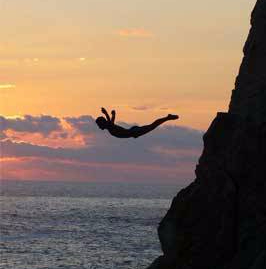
Jumping Off a Cliff

The other day, I was thinking about how love works. There are, some say, many different kinds of love. Parental or ‘paternal’ love is one. Romantic love is another. The love between friends, the love between siblings … all real, all serve to soften the edges and warm the heart as we traverse the predictably rocky path of life.

I like the way M. Scott Peck talks about it:

Love is the will to extend one’s self for the purpose of nurturing one’s own or another’s spiritual growth… Love is as love does. Love is an act of will — namely, both an intention and an action. Will also implies choice. We do not have to love. We choose to love.” 

There’s a kind of love that keeps us going … in pursuit of a dream, pursuit of justice, pursuit of a passion. Sometimes even pursuit of a relationship. There’s the warmth of camaraderie between people who share interests — in music, theology, writing, art.

C.S. Lewis describes the recognition between kindred spirits:

“Friendship … is born at the moment when one man says to another “What! You too? I thought that no one but myself . . .” 

The backside of love is the broken heart. Love and heartbreak are two sides of the same coin. We jump off the “love cliff” and fly for awhile – months, years, decades – but eventually experience the crash of loss at the end. Sometimes it’s the soft landing of age and knowing that it’s time. Other landings are sudden, unexpected, hard. Unforseen crashes leave our heart in pieces.

Somebody said it, though I can’t remember who … one of my favorite philosophers, I’m sure. He said the beautiful heart has been softened by being broken over and over again; it has been turned to grains of sand.

I love that analogy. For a heart to be in that state, the person has chosen love every time, knowing the crash always comes.

Those who jump off that cliff again and again are valiant. And yet, what are the other options? What would life look and feel like if we stayed away from that jagged edge, safe and secure, never jumping at all?

According to C.S. Lewis, we have that choice:

Love anything and your heart will be wrung and possibly broken. If you want to make sure of keeping it intact you must give it to no one, not even an animal. Wrap it carefully round with hobbies and little luxuries; avoid all entanglements. Lock it up safe in the casket or coffin of your selfishness. But in that casket, safe, dark, motionless, airless, it will change. It will not be broken; it will become unbreakable, impenetrable, irredeemable. To love is to be vulnerable.” 

So yes, to love is a choice. And yes, it is a brave choice; we step into our own vulnerability when we open ourselves to it. But, given what Lewis describes as the alternative, it’s really the only choice to make, isn’t it?

Here’s what it comes down to: it’s love that keeps us glued together inside our own skin. It’s the connective spark that pulses through us, the flame that puts the light in our eyes.  it’s the sweetness that makes everything else worth breathing for. It’s what we’re made of. And it’s the stuff of Who made us. Love and dust. So, really, what do we have to lose?

Let’s jump.

::MY ROOM::

still-life-with-lace-painting-mediumIt sat in the back corner of the house. There were two doors, one off the kitchen, and one into the boys’ bedroom.  The windows were on two sides, big and drafty. In the winter, Jack Frost made icy paintings on them. I loved it. Sometimes I would lick the ice, and watch it melt.
The wallpaper in my room was from Swinney’s hardware, my uncle John’s hardware store.

I loved that store. It had hardwood floors, front to back. There were wooden stairs to a catwalk that ran all the way around the at the second floor level. The walls up there were a checkerboard of colorful wallpaper samples. Lift the flap of paper, and the rolls of paper were stored in the cubbies behind.

My grandmother chose the wallpaper in my room. It was white, with loose bouquets of wildflowers tied with trailing blue ribbons. During the paper selection process, I was asked if didn’t I like this, or didn’t I think that was pretty. I loved looking at the samples, and leafing through the big wallpaper books. But I didn’t know what I liked. I was eight. I just wanted to make the adults in charge happy; I wanted whatever it was they wanted, because that makes everyone happy, right? Then I don’t get it wrong. That’s what you think when you’re eight.

Later, I would decide that my room looked old ladyish, I was silently disgruntled that my grandmother had picked it out … though even at ten or twelve, I didn’t know what I’d have chosen. Thinking back, I can see it was a sweet, cheery space in that stark little house. I wish I could see that paper now. I’d probably love it.

One of the things in my room was a wicker desk that had belonged to the mother of my other grandmother. My great grandmother. White wicker, with a wicker chair. That little desk has followed me all over the country, throughout my adult life. And it currently sits int eh bedroom at my house that is used by my granddaughters.

I wonder if it will some day be taken, and treasured, by my granddaughter, Gabby. There’s no way to know … but I hope so.

Meanwhile, thinking back, I love picturing that little white desk in my childhood bedroom; the wallpaper of flowers and the white dotted Swiss Priscillas. It’s where I laughed, cried, prayed, slept, and dreamed.

It was my room.

::ON FLAILING::

Flailing Drawing

Talking with my mentor today about flailing. Actually, we were talking not only about our own, but also about a mutual friend’s flailing. The friend’s really good at it. God bless her, she’s begun so many careers, projects, ideas, but somehow nothing ever sticks. Add all that to the list, and she one of those who looks real good on paper. But her specialty, if she was going to be honest with herself – which, at this point, not so much – is flailing. As I said, and I mean it … God bless her.

We all flail. Some of us flail occasionally, some do it daily, as a normal response to living, period.

Martha Tinsdale

I love the show ‘Good Witch’ on Hallmark Channel. Martha Tinsdale, the town’s Mayor, is a flailer. She’s skittish and going off about something pretty much all the time.

Cassie Nightingale, the owner of the little shop, “Bell, Book, & Candle,” is calm as the lake on a still day. She’s direct, thoughtful, and soft spoken.

She almost never shows her flailing. So she’s the one many turn to when Cassie Nightingalethey feel their own flailing going out of control.

I can identify with both Martha and Cassie. I feel the skittish “Martha” energy kick in when things take a troubling turn. Unlike Martha, my flail is usually internal. “Closet flailing” … like what goes on in deep water. Surface calm to the naked eye. All hell breaking loose below. It doesn’t often last very long, just a few minutes. An hour or so at most. But there’ve been periods in my life when, being under assault, I’ve experienced active “peripheral flailing” on a twenty four hour basis. For weeks at a time. Months, even.

But my exterior is generally calm. When I’m in that scrambling space, very few people know it.

I’m always striving to zero in on the path to calm. To my “Cassie place.”

There are those who seek shoulders, and those who are the shoulders being sought. Shoulder seekers tend to be the flailers, the Marthas of the world. Those who offer shoulders are the ones who present calm, dependable energy … the “Cassies.”

And, you know, life is messy … it tends to flail on its own from time to time. Traffic, crowds, water pressure … it all flails. And that’s okay.

Because there is a point at the center of it all where the quiet reigns. And all the flailing, the flagging about, is a misguided attempt to get “there.”

So my mentor and I, having chatted this subject through, are laughing about our own scatter shots, our flailings … and are glad that we have each other to hold the peace.

We’ll call it, “Holding Peace While Flailing.” Cassie and Martha would be proud.

::The Space Between::

Empty Space

I’ve heard there’s a way to live that is without pressure, or obligation. A way to avoid the mundane requirements of life; electric bill, rolling trash bins to the curb, changing batteries in the smoke alarms. I’m not real clear about how one achieves that no-pressure life without ending up under a bridge somewhere. I do feel pretty certain that there’s a way to find balance along the nothing/everything continuum.      

                   
I was watching Hoarders the other day. In fact I was watching Hoarders back to back. I was sort of hoarding 
the Hoarders series. I keep thinking about those people and wondering, what was their trigger? What was the last straw that caused that interior designer to pile her historic home so full of crap that she ended up living in the driveway, in her dilapidated van with her dogs? That when the cleanup people were climbing over the piles inside the home, she was cheerily bragging on it being her design studio? In her mind and eyes, there was no problem.

HoardingShe literally hoarded herself out of her home. She crowded herself out of her life with stuff. And though she declared the high value of it all, much of it was … nothing but garbage.

Another woman’s home was over run with  cottage cheese cartons, rubber bands – which she had huge piles of, and wouldn’t let the cleanup people touch – plastic bags. Anything. Everything. It appears that too much everything flips over and you get nothing.

I’m thinking balance. It’s a great term, most of us use it, and most of us think that, in some way, we have some sort of balance in our lives.

Those hoarders think they have balance too. Like the woman whose house was so filled with crap she was living in the makeshift aviary with her cats. She couldn’t live in her house. She cried. She didn’t want to let anything go, but at the same time knew she had a problem.

Not sure why I’m writing about this. What I’m sure of is, I need to hire a couple of teenagers to help me clean out my garage.

You never know when that last straw’s gonna show up.

::Binding By Heart::

Connections. They’re so interestheart-stringsing. Commitments. Promises.

All my life, I thought those things meant the same to everyone else as they did to me. The ties of attachment are strong, invincible, able to weather any storm. Right?

I guess the only way that holds true is when the heart is an intrinsic part of the threads that weave together. When it defines the bindings that pull us in, hold us close. That compels us to dig in, to see things through.

There are some people who make commitments, make promises, but they don’t seal them with the heart. The ties they bind with are paper thin, easily broken. Often by design.

I don’t know, but it seems like they leave that crucial thread out as a way to – eventually – turn away. To break. To run. They were never fully ‘there’ in the first place.

For the heart-driven, it often looks in retrospect like a fool’s journey. Were we played? Were we taken for a ride? Probably so. But for our part of the experience the love, the promise, the commitment was there … even if it only came from us.

This world is full of two types of people: Dreamers, and Cynics. The Dreamers are heart-binders. The Cynics are … not. I know this because, as a Dreamer myself, I have a history of binding-by-heart to Cynics who bind-until-the-going-gets-rough. I’m not complaining, just observing from a place of weary wisdom. From a place where, by now, I know to pause, to observe, to wait … as long as it takes for someone to show their true selves. Sometimes that means waiting a lifetime.

::MYSTERIES OF MAMA::

Mama, Close Up

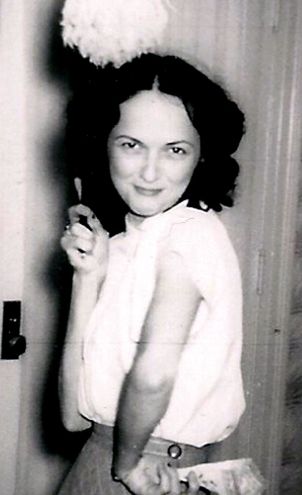
This picture was taken when we lived on South Madison. In it Mama is her beautiful, comical, musical self. Back then she would strike a pose, then collapse in laughter. She had flair, a free spirit,  she was my personal movie star, even before I knew what movie stars were.

I’ve gone back and looked through as many events as I can remember, trying to piece things together.

I’m searching for the turning point. To find when things changed. When the sun stopped shining, and the world went from bright colors to shades of grey.

I remember we had moved to the little house on North Marion. The one with the crayon blue linoleum floor. I remember a pivotal darkness, but nothing will speak to me from there. I try to go inside that space, but it’s always …. like the memories in it are right on the tip of my brain. I can almost see them. But not enough to grab hold, and to understand.

The things I know are that they had friends back then. At night they would get dressed up and go out together, and leave me with Ma Welp. But what else was happening?
I remember kitchen cabinets, with the doors open. Mama’s friend was rearranging. I remember Mama crying, and putting things back in the right places after the friend left. It was during that time that she stopped laughing.

I remember the priest coming. I remember feeling confused, and then it fades to black.
After whatever happened, that friend who was changing Mama’s kitchen never came over anymore.

Years later, when she was into her cups and in the mood to offer sage advice, she would say that you should never let anyone into your life because they’ll just walk in like they own the place and take over everything. Never get too close to anyone, she said. That’s the only way you can be safe, she said.

I’ve always wondered if that was the philosophy she used through the years to stay so far away from me. We’re closer now than ever before because, at 92, she has no clue who I am. It is a brokenhearted comfort that she always says she’d “love to get to know you.” I’d like to get to know you too, Mama. Or at least to understand what happened that kept us separate. But whatever it was, I loved you so; I choose to know that you loved me.I’m reminded of Birdie’s mother saying,

“All mothers love their daughters, even if they show it poorly.”

::THE GANG’S ALL HERE::

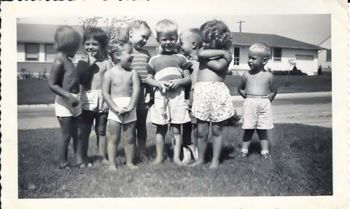
Celia and her buddies

If three year olds can be gang members, I was one. We had a pack of kids in our neighborhood on North Marion Street. Each morning, as early as any parent would allow, a youngster  drifted out the front door of his little clapboard house, and stood in the yard wearing nothing but a pair of rumpled camp shorts. Maybe he’d wander the length of  the driveway, bend down, pick up a rock, survey the street for signs of life, and head back to sit on his porch stoop. And wait.

Almost immediately, sets of young eyes threw quick glances out picture windows. Front doors opened, and small, tan feet ran or skipped or sauntered to assemble where the child was planted.

Thinking back, it gives new meaning to “the gang’s all here.” But we were.  The men in our gang wore shorts; the women, bloomers. We were brown as biscuits, the soles of our feet  well seasoned from weeks of running around bare.

We played all day, moving in a raggedy clump from one yard to another. Bill’s dad had left the hosepipe hooked up on the front spigot, so we all ran over because Shorty and Margo were thirsty. Mitchell and Bobby turned the handle, and the water spurted out. It went quickly from hot as fire to so clear and cold that suddenly we were all thirsty. Everybody got a chance. About eight or ten three year olds bending over spouting water, slurping it down their throats and bellies, all of us clamoring for more.

I don’t remember every name from back then, but I remember that water.  It started in Lake Spavinaw, and came pouring out of that front yard hose icy and sweet, flavored with a touch of rubber hose and a dash of brass metal. We all loved it, and kept drinking until Bill’s mother came out on the porch to shake the dustmop and caught us.

“You kids turn that water off and go play!” she hollered. She gave us the hard eye till Bill went over and cranked the handle.  By that time we were soaked, but we didn’t care. In fact, we liked it. It was 90 degrees in the Oklahoma shade, which there wasn’t much of.

Our gang lasted till we all started school, then life its own self took over and we drifted into our separate worlds. But if anyone ever asks me about gang membership, I can tell them, quite honestly, that I was a gang member very early on. And I’m proud of it.

::BROKEN HEARTS ARE RED::

GLASS HEARTWe’re living in very difficult times. We have every modern convenience,  every means of communication, yet we live lives of anguish and isolation. Our ability to communicate, and to assess the subtle nuances of truth-versus-lie is tied directly to our face to face human interaction. You’d think we’d have more of that than any generations before us. But we don’t.

Ironically, psychologists tell us that our children will have less ability than any generation in history to interact with others in healthy and meaningful ways. The reason is because they spend far more time looking at a tablet screen than they do looking into the eyes of another human being.

And I totally get that. I can’t hear someone’s vocal inflection in a text. I can’t sense their energy or see their facial expressions in an email. In my head and without realizing it  I write the story, I infuse the tone, I define the intent. That is what determines how I “hear” them. How often am I correct? How often have I gotten it wrong? I can’t know, because the moment in which it happens is gone in an instant. I’ve reacted based on “my assessment” before I even think about it.

And this, I contend, is how we have gotten so far away from each other.

Then there is the media. Do we really know what’s happening in this world? Or why? Are we given all the facts of a situation, and trusted to draw our own informed conclusions? No. There are extensive, complicated algorithms and processes that media uses to decide what we should be told, when, and how. The goal is to “drive” our opinions and conclusions; to create outrage, cause us to take sides, and define others as ‘good’ or ‘bad’ based on what we “know.” And the result is that we end up unable to debate or agree-to-disagree.

But … what is it that we really know?

I can’t say definitively. I’m honestly still searching, and I feel more confused than ever before.

But here are a few basic conclusions I’ve reached:

  • I know that things are happening at high levels over which I have no control.
  • I know that every story or event reported on is colored by the reporter’s bias – be it strong or subtle – so that I will believe I “know” something that may not be the whole truth or the whole picture.
  • I know that it takes deliberate and brutally honest energy to dig into the volume of information … to find those missing pieces of the puzzle that make the picture whole, and true.
  • I know that if I claim to be a seeker of truth, I have an obligation to the whole truth, regardless of what I might think about it.
  • I know that people need each other. The separation we feel is an illusion. We are connected to each other.
  • I know that we are more alike than we are different. Like flowers in a garden that thrive in the same dirt, drink the same water, and bloom under the same sun, we are a world of beautiful humanity, all created by the same God.
  • I know that hearts are broken every day in a variety of ways. But generally speaking, it’s always about loved ones lost, either through death or separation.
  • I know that when any person, anywhere, feels overcome with that loss, that it feels the same everywhere.
  • I know that all broken hearts are red.

Blog at WordPress.com.

Up ↑