::WHAT SAVES US::

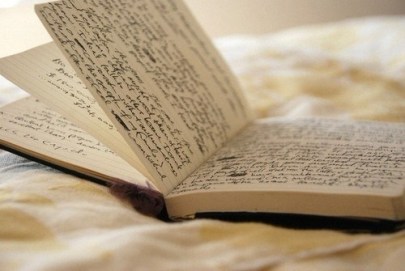
Notebook of Writing


It’s a grey Monday, and I’m ‘working at writing’ in a session with Amy Lyles Wilson, my editor. I say ‘my editor,’ because that sounds very official, doesn’t it? And she is my editor; she’s also a dear, trusted, and longstanding friend. The fact is, I’m not sure how a writer/editor relationship could work otherwise.

It’s a courageous thing, writing. As Hemingway says, ‘There’s nothing to writing; all you do is sit down at a typewriter and bleed.’ That’s the long and the short if it, right there.

The first draft of my book is finished. Yes, I deliberately “buried the lead” here. Because I’m not entirely sure how I feel about it. I’ll tell you this: it was with a weary, a relieved, and an ultimately dispassionate resolve that I finally finished that draft. And I’m a bit nervous about all the soul bearing stuff I wrote down in those 177 pages. I’d like to change my mind about some of it. But that would require a rewriting of my little piece of history. Truth lives on those pages, for better or for worse. Now, all I can do is breathe.

Writing is an excavation of the heart. When it’s about your own life, about how you got to here from there, it is a staunch enterprise. There are days — many — when you’re riddled with the thought that nobody could possibly be interested. Why would they care? Why am I doing this? But you continue on determined to, at the very least, finish what you started.

And so, you do. It might take twenty three years. You might, in 1995, get an official invite-to-submit from a major New York agent and knock yourself out writing enough to send her a sample. You might even get a letter back, saying she loves your work, that it feels “introductory,” and to please send more when your book is further along.

It’s March, 2018. That letter is in my file drawer. Wonder if she’s still interested.

The fact is, we all have stories. Amy’s slugline on her website is, “It’s the sharing of our stories that saves us.” And nothing could be more true. The funny stories, the heartbreaking stories, the stories that, when the readers read them, make their eyes well up or their hair catch fire … the hard stories.

The stories that don’t want to be written; the ones hiding in the shadows. THOSE are the stories we must write. And that’s what I’ve done.

There are more stories from different periods in my life that may need telling, if only for my children. Stories of my own childhood. Stories of my dreams, what they were, when some of them were abandoned, and why. For whom. And the resulting life that came after. The fact that, in this one lifetime, I’ve lived what could be classified as three distinct incarnations.

I’m in the third incarnation now, and closer to the end than I’ve ever been. With each passing day I pray, and wonder, and hope, and love. Even at this age, I feel the same creative passion and zest for life that I felt in my twenties. Those of you reading this who aren’t yet where I am, you’ll be here one day; you’ll think of this passage and realize the truth in what I’m saying to you now.

So yes, it’s a grey day of writing, and we’re here at this table, doing just that. I wouldn’t be here at all if I had no story to tell. The thing is, we all have stories inside us, wanting to be told. Let’s write them down. It may, indeed, be what saves us after all.


http://www.amylyleswilson.com


::JUMP::

Jumping Off a Cliff

The other day, I was thinking about how love works. There are, some say, many different kinds of love. Parental or ‘paternal’ love is one. Romantic love is another. The love between friends, the love between siblings … all real, all serve to soften the edges and warm the heart as we traverse the predictably rocky path of life.

I like the way M. Scott Peck talks about it:

Love is the will to extend one’s self for the purpose of nurturing one’s own or another’s spiritual growth… Love is as love does. Love is an act of will — namely, both an intention and an action. Will also implies choice. We do not have to love. We choose to love.” 

There’s a kind of love that keeps us going … in pursuit of a dream, pursuit of justice, pursuit of a passion. Sometimes even pursuit of a relationship. There’s the warmth of camaraderie between people who share interests — in music, theology, writing, art.

C.S. Lewis describes the recognition between kindred spirits:

“Friendship … is born at the moment when one man says to another “What! You too? I thought that no one but myself . . .” 

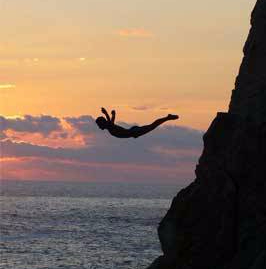
The backside of love is the broken heart. Love and heartbreak are two sides of the same coin. We jump off the “love cliff” and fly for awhile – months, years, decades – but eventually experience the crash of loss at the end. Sometimes it’s the soft landing of age and knowing that it’s time. Other landings are sudden, unexpected, hard. Unforseen crashes leave our heart in pieces.

Somebody said it, though I can’t remember who … one of my favorite philosophers, I’m sure. He said the beautiful heart has been softened by being broken over and over again; it has been turned to grains of sand.

I love that analogy. For a heart to be in that state, the person has chosen love every time, knowing the crash always comes.

Those who jump off that cliff again and again are valiant. And yet, what are the other options? What would life look and feel like if we stayed away from that jagged edge, safe and secure, never jumping at all?

According to C.S. Lewis, we have that choice:

Love anything and your heart will be wrung and possibly broken. If you want to make sure of keeping it intact you must give it to no one, not even an animal. Wrap it carefully round with hobbies and little luxuries; avoid all entanglements. Lock it up safe in the casket or coffin of your selfishness. But in that casket, safe, dark, motionless, airless, it will change. It will not be broken; it will become unbreakable, impenetrable, irredeemable. To love is to be vulnerable.” 

So yes, to love is a choice. And yes, it is a brave choice; we step into our own vulnerability when we open ourselves to it. But, given what Lewis describes as the alternative, it’s really the only choice to make, isn’t it?

Here’s what it comes down to: it’s love that keeps us glued together inside our own skin. It’s the connective spark that pulses through us, the flame that puts the light in our eyes.  it’s the sweetness that makes everything else worth breathing for. It’s what we’re made of. And it’s the stuff of Who made us. Love and dust. So, really, what do we have to lose?

Let’s jump.

::ANGEL TONGUE::

GIRL SINGING

I am a vocal coach.  I just read that sentence, and it sounds a little strange to me.   Coach vocal.  Voice.  Coach voice.  The definitions of “coach” are all over the place, from a “four wheeled, horse drawn carriage,” to coach as: “developing a person’s skills and knowledge so that their job performance improves, hopefully leading to the achievement of organizational objectives.”

Voice is defined as: “the sound or sounds uttered through the mouth of living creatures, especially of human beings in speaking, shouting, singing, etc.”

I’m sure Miriam or Webster or whoever it was that determined those definitions … I’m sure they were a sharp couple of guys.  I mean, they know the definitions of EVERYthing, and actually put it in a book called a dictionary.  But neither one of these  guys has shown up to observe what happens when an individual is standing in front of me, aching to sing, but scared shitless to do it.

“I need you to sing something.”
“You mean, NOW?”

“Yes.  Now.  You can sing the alphabet, you can sing Happy Birthday, I really don’t care.  I  just need to hear your voice.”

And so it begins. Without exception, every . one . can . sing.  I didn’t say everyone is a singing star, but singing is as natural a part of us as breathing.   Yet so many tend to be paralyzed at the thought of letting their sound out for the world – or, for that matter, themselves – to hear.

Singing, “being of music,” is natural for us all; we speak the language of angels. So the fear is of speaking in the angel tongue.  There resides in many a sense of unworthiness (untrue), of not measuring up (the big lie), born of a lifetime of people telling them they can’t do it well enough, and to stop (defamatorily inaccurate) .  So I guess, woven into this work I do, is the psychology of gently leading people back to their own truth, and creating a space where they – when they’re ready – will step  into it.

The body is a reed instrument.  As with any reed instrument, playing it requires breath.

I tell every student  that  at the moment they popped out of their mama, with that first breath they gulped in Spirit; they have been doing it every moment ever since.  Ironically, when they first start working with me, people often  find it difficult to breathe.  They become “breathless.”  So we work on the process of permissions … to breathe (doing it already), to have a voice (has always been there), to raise that voice, to speak in tongue … angel tongue … the native language of the universe.

I just think Miriam and, for that matter, Webster, should sit in on a couple of my students’ sessions.  I think they’d be surprised.  Maybe they’d even sing.


::Every Little Piece::


Raindrop


People always ask me when I started to write.  Especially songwriting.

I can think of points along my childhood and teen years, when I wrote to process feelings or moments; heartbreak. Confusion. Boys. But the truth is I’ve always, as long as I can remember, written it down.

I say that, and it strikes me quite odd that a tiny girl, not exposed to literary pursuits, would even think of writing.

I was a post war baby; my mother and daddy were young, beautiful, hard working. My daddy was a Navy man, and knew how to do just about everything. They were musical, and funny, but they were not the type to bury themselves in Tolstoy or Hemmingway. They had better things to do: roll up the rug in the dining room on Saturday afternoon and dance to Benny Goodman and Kay Starr records. Or sit on the front stoop at sunset, leaning into each other, beer in hand, and watch the kids ride their trikes in the driveway.

So how did I end up here, at this keyboard? Or way back there, at that Big Chief tablet with my Dixon Laddie #304?

I remember a moment when I was five. I was sitting on the swing in the back yard at 1563 North Marion. The sky was so blue, and I was so happy, I wanted to write a song about how I felt. I threw my head back, and instead of words coming out, I cried. My happy went heartbroken in that moment; I wept, because I knew I was too little to write a song that sounded like the ones on the radio.

And it’s interesting, isn’t it? How I remember that moment so clearly. How even as I think about it, I am “back there,” under that blue sky. In that back yard on that swing. My stomach even grabs for a second as the feelings I had then are here with me now.

So I guess you could say the writing thing has always been part of what I am. I remember in first grade, Sister Dianna was teaching us a song, and I was saying the words with her. She stopped, looked at me, and said,

“Mary Cecelia, do you know this song already?” No, I didn’t. I’d never heard it before. But somehow, I knew what would come next in the lyrics. Didn’t everybody? No, it turns out. They didn’t.

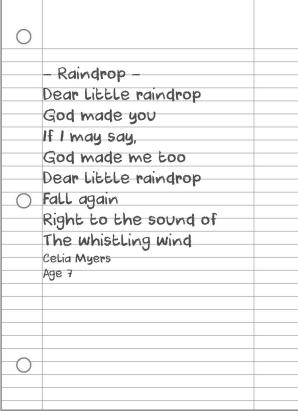
In third grade, Sister Mary Damien announced that the Highschool newspaper class was asking for poems from the grade school. They were going to publish one poem in the next edition of their paper. We were to turn our poems in the next day. My hear jumped, and my head started spinning with the tomes I would write.

That night at home, I took out my Big Chief tablet and my Laddie pencil, and I wrote. I wrote at least a half dozen one-stanza poems. I gave each stanza a name, and its own sheet of lined paper. I made the pages as neat as my third grade southpaw printing could get.

The next morning, I shuffled into the classroom with my classmates, laid my stack of poems on the corner of Sister’s desk, and took my seat. I watched her eagerly, hoping she would be proud of me.

Finally, Sister Damien walked over to her desk and picked up my pages. She leafed through them, then ripped them in half and threw them in the waste basket. As she did so she looked up at me briefly and stated,

“You were not to copy out of a book.”

My stomach lurched. My face turned hot. My eyes welled up. I was horrified, for several reasons:

First, it would never have crossed my mind to turn in someone else’s work; the fact that she thought I would do such a thing made me want to cry.

Second, even at seven years of age, I was in a panic: those were the only copies I had. I learned an important lesson that day: always make duplicates.

Third, though my classmates were laughing at me, I was more concerned with people thinking I had such a flawed moral compass. They clearly didn’t know me at all.

On another level, buried deep beneath my chaotic feelings, was a little voice that whispered,
“Hmmm. They must have been good. REALLY good. She thought you copied them out of a book.”

A backhanded compliment from a nun, saying my work was so good I could not have done it. I’ve lived a lifetime of twisted victories like that.

In fourth grade, we had music class two mornings a week. One morning the music teacher announced that there would be a music program, and that we would be in it. She then said to the class,
“We will need someone to sing the solo. Are there any solo singers in here?”

The entire class turned, without a sound, and pointed at me. All I’d ever done was sing with everyone else.  I was completely unaware of my own voice. With all those fingers and eyes directed at me, I buried my face in my arms and cried.

Eventually I did sing the solo in the program that year. And I kept writing. There were times, big stretches in fact, when I was writing for my life. And music is the silver thread that’s always kept me tethered here.

In fact, writing and music have laced the pieces of my life together, helped me make sense of myself, this world, and the path I’m on. They still do.

I used to think maybe these things were pieces of generations past, pulling me back. But I’m starting to believe maybe they’re pieces of the future, pulling me forward.

Either way, I’ll take it. And I’ll write and sing the pieces of my life together, for as long as I’m here.


Blog at WordPress.com.

Up ↑