::THREADS::

Tapestry

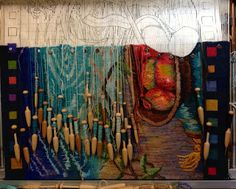
Things tend to make sense in ways we don’t expect. Sometimes situations or events go what we’d normally call out of control … all we can see is the chaos. But a step back reveals the wider net, the bigger picture. The choreography, the symmetry of all things.

Relationships. Blood, love, hate, passion. The binding thread that brings them all together is fiery red. But in it … when we’re in it … it feels like drowning, or flying, or crashing. No color at all. Just the grit and grind and focus of getting through it, or holding on to it, or getting rid of it, or expressing it. That is the experience of the thread itself. We are that thread.

Blue. Of Jazz, pain, loss, rain, regret. The thread of blue awakens quickly with each event. Fluid and flexible or vulcanized and unyielding … this strand goes from silk to steel in an instant, its transformation governed by the emotional dictates of experience.

And yet, when we lay our heads down in the dark, all threads come together; as we sleep through the night they work in concert, weaving another length in the tapestry of our lives.

::BROKEN HEARTS ARE RED::

GLASS HEARTWe’re living in very difficult times. We have every modern convenience,  every means of communication, yet we live lives of anguish and isolation. Our ability to communicate, and to assess the subtle nuances of truth-versus-lie is tied directly to our face to face human interaction. You’d think we’d have more of that than any generations before us. But we don’t.
Ironically, psychologists tell us that our children will have less ability than any generation in history to interact with others in healthy and meaningful ways. The reason is because they spend far more time looking at a tablet screen than they do looking into the eyes of another human being.

And I totally get that. I can’t hear someone’s vocal inflection in a text. I can’t sense their energy or see their facial expressions in an email. In my head and without realizing it  I write the story, I infuse the tone, I define the intent. That is what determines how I “hear” them. How often am I correct? How often have I gotten it wrong? I can’t know, because the moment in which it happens is gone in an instant. I’ve reacted based on “my assessment” before I even think about it.

And this, I contend, is how we have gotten so far away from each other.

Then there is the media. Do we really know what’s happening in this world? Or why? Are we given all the facts of a situation, and trusted to draw our own informed conclusions? No. There are extensive, complicated algorithms and processes that media uses to decide what we should be told, when, and how. The goal is to “drive” our opinions and conclusions; to create outrage, cause us to take sides, and define others as ‘good’ or ‘bad’ based on what we “know.” And the result is that we end up unable to debate or agree-to-disagree.

But … what is it that we really know?

I can’t say definitively. I’m honestly still searching, and I feel more confused than ever before.

But here are a few basic conclusions I’ve reached:

  • I know that things are happening at high levels over which I have no control.
  • I know that every story or event reported on is colored by the reporter’s bias – be it strong or subtle – so that I will believe I “know” something that may not be the whole truth or the whole picture.
  • I know that it takes deliberate and brutally honest energy to dig into the volume of information … to find those missing pieces of the puzzle that make the picture whole, and true.
  • I know that if I claim to be a seeker of truth, I have an obligation to the whole truth, regardless of what I might think about it.
  • I know that people need each other. The separation we feel is an illusion. We are connected to each other.
  • I know that we are more alike than we are different. Like flowers in a garden that thrive in the same dirt, drink the same water, and bloom under the same sun, we are a world of beautiful humanity, all created by the same God.
  • I know that hearts are broken every day in a variety of ways. But generally speaking, it’s always about loved ones lost, either through death or separation.
  • I know that when any person, anywhere, feels overcome with that loss, that it feels the same everywhere.
  • I know that all broken hearts are red.

::MAYBE::

Pontiac Hood Ornament

Things in my life are the way they are, based on every choice I’ve made. They laid a road, end to end, that brought me here to this table today. Good or bad, for better or worse, here I sit; my greasy hair under a ball cap, my thoughts scattered and the censor in my brain telling me that what I’m writing now is not worth a damn.

I get sick of hearing my own voice tell my own stories. Are other people as sick of it as I am?  I don’t want to write cute, or clever. As Hemingway says, write real, about what hurts. I’ve kerfed around the edges of the pain for years, never hitting it dead center. I guess that’s real if you’re digging a trench, but I’m sort of stuck down here, looking for truth. And trying to dig my way out.

I could write about birds. But then my brain goes to the parakeet we had at 1135 South Quaker. My mother named it Perry Como. He was blue, with black wing tips, and a spot of lime green between his eyes. Thinking of him now I can smell his birdseed and that cage with the newspapers in the bottom.

When they let Perry out of that cage, he flew up and sat on the curtain rods. Every time he flew his wings made a loud flapping sound that scared my little brother.

Sometimes my mother would open Perry’s cage door, and wait. When my brother came walking through the livingroom, suddenly Perry would swoop down. My brother would scream and dive under the table, clutching the legs and sobbing. My mother raised her eyebrows, took a drag off her cigarette, and laughed. That taught me some pretty twisted things about how people treat those they claim to love. So yeah … count that little nugget as a lob to the center of the pain from the trenches.

Or maybe I could write about being a teenager. And dating.

Maybe I could write about the night a boy came to pick me up, and he had a long fringe of bangs. My little sisters peaked around the door giggling, “It’s a Beatle!” My Dad growled, “Is that your hair, boy, or is that a wig?”

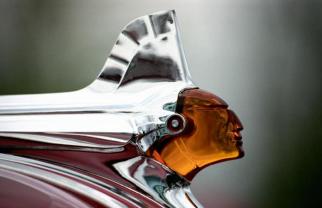
Or I could write about another time my date arrived to take me to the school dance. He drove his car, parked, and my Dad drove us to school in our ’51 two door Pontiac. The two door thing is relevant because my date and my Dad sat in the front, I climbed into the back. In my formal. The thing I’ll never forget is the hood ornament. It was a glowing orange Indian Chief. I locked my eyes on that thing all the way to school, trying to ignore the awkward silence.

Maybe I could write about the faith, and the sense of humor, that have carried me on angel wings through the darkest of days, the brokenest of hearts. How, even in those moments … my date with the Beatles hair, me sitting in the back seat of that car … even then, in the recesses of my mind, I knew: “this is the rich stuff of which stories are made. I will write about this one day.”

Maybe today, sitting here at this table, wearing my ballcap, is that time.


::Right or Wrong::

right-or-wrong imageThe messages we’re given in childhood are powerful. Until we get out into the world on our own, they define our reality. They define our normal. They tell us what’s expected of us, and what value we have. And behind those front doors, each family has its own brand of ‘normal’.

I was raised in a house where there was one right way to do everything. Often I discovered there was a right way after I’d done something the wrong way. Mattered not if I accomplished my goal. If I didn’t do it the right way, I got it wrong. And that “right” way could change without warning; I learned that early on. So, go ahead, knock yourself out. But don’t count on anything except maybe being blindsided by a new rule, a new way of you failing again.

This is a piece of the legacy inherited by a child of alcoholics. Eventually, once we’ve reached adulthood and if we’re aware enough and brave enough to launch the quest for self discovery, we catch a glimpse of how life is defined outside the hazed cocoon in which we grew up; the only “normal” we’ve ever known. So there’s an overriding sense of betrayal, or having been lied to about ‘what’s going on out there’, ‘how I fit in the world,’ or even ‘who I am’. And, at its center, ‘what love feels like’.

That’s not to say that drinkers are evil. They’re not. I truly believe that very person, in one way or another, is ‘trying to find their way’. But some people get so off track; are so myopic as to what they’re doing and the damage caused by it, that they’re pretty much a walking (or stumbling) wrecking ball.

I’ll admit there are certainly things ingrained in me from my childhood that I treasure. I have a very well calibrated moral compass. I’m not an angel by any stretch, but when I’ve veered off course, I know it.

This comes from a Spiritually driven center that was awakened in me very early on. I clung to it, and was convinced that ‘if I’m good enough’ good things will, ultimately, happen. There’s probably a piece of me that still believes it.

In Seminary we studied addiction. It was pointed out to us that addicts are “headed the wrong way down the right road.” They crave a different feeling, a different perspective. But they’ve employed chemical shortcuts to get there, which always end in failure. Because in order to keep the feelings gained from drugs or alcohol, you have to stay drugged or drunk. The process is deeply and heartbreakingly flawed. Those same good feelings are authentically available. But like all things of true value, we gotta do the deliberate, serious (and personal) work to ‘get there from here’.

And something else I learned  in Seminary, is that there are quite possibly as many ways to do something as there are people to do it. Not right or wrong, based on approach. When I heard that it was not like a light went on in my head; it was more like a bomb went off.

For decades I held back on doing so many things, big and small, for fear I would do them wrong. It was earth changing when, after finally trying something, and doing it my way, there was no one there to tell me how wrong I was.

Maybe I was never really wrong, after all.

::BLESSINGS::

Heart in Water

There was a period, not sure how long, during my growing up when I remember being blessed. I’m not talking about blessings abounding, though looking back I’m able to see that some did. I’m talking about the ritual of Good Night.

After pajamas on, teeth brushed, I was summoned to stand before my mother. She rested her hands, softened  and smelling of Jergens lotion and tobacco, on my head.

“I bless you in the name of the Father and the Son and the Holy Spirit,” she droned. Her breath carried the DNA of Brown Derby beer.

There were no kisses. No hugs. Just a blessing.

Then one night, after the blessing, I posed a timid question.

“Aren’t we supposed to kiss and hug, or something?”

“You got a blessing. Go to bed.”

So I guess, when thinking about “being blessed,”  this memory peaks up to remind me that those blessings did happen.

Regardless of what she’d been smoking, or drinking, the blessing was its own thing. A spiritual lifeline thrown to a little girl by a mother who knew no other way to tell her she was loved.

Every night, for as long as it lasted, I grabbed that line and held on for dear life.

That lifeline became a lifeboat, one that has carried me from stark childhood to rocky marriage to the open sea of tender possibilities. I know now that sometimes a brokenhearted love lies hidden in the coldest blessing, aching to be thrown a line of its own.

::Every Little Piece::


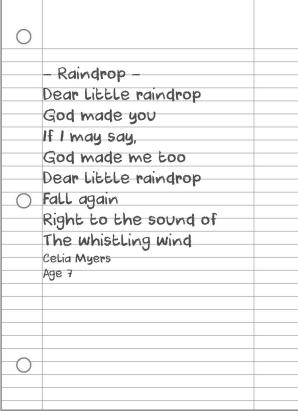
Raindrop


People always ask me when I started to write.  Especially songwriting.

I can think of points along my childhood and teen years, when I wrote to process feelings or moments; heartbreak. Confusion. Boys. But the truth is I’ve always, as long as I can remember, written it down.

I say that, and it strikes me quite odd that a tiny girl, not exposed to literary pursuits, would even think of writing.

I was a post war baby; my mother and daddy were young, beautiful, hard working. My daddy was a Navy man, and knew how to do just about everything. They were musical, and funny, but they were not the type to bury themselves in Tolstoy or Hemmingway. They had better things to do: roll up the rug in the dining room on Saturday afternoon and dance to Benny Goodman and Kay Starr records. Or sit on the front stoop at sunset, leaning into each other, beer in hand, and watch the kids ride their trikes in the driveway.

So how did I end up here, at this keyboard? Or way back there, at that Big Chief tablet with my Dixon Laddie #304?

I remember a moment when I was five. I was sitting on the swing in the back yard at 1563 North Marion. The sky was so blue, and I was so happy, I wanted to write a song about how I felt. I threw my head back, and instead of words coming out, I cried. My happy went heartbroken in that moment; I wept, because I knew I was too little to write a song that sounded like the ones on the radio.

And it’s interesting, isn’t it? How I remember that moment so clearly. How even as I think about it, I am “back there,” under that blue sky. In that back yard on that swing. My stomach even grabs for a second as the feelings I had then are here with me now.

So I guess you could say the writing thing has always been part of what I am. I remember in first grade, Sister Dianna was teaching us a song, and I was saying the words with her. She stopped, looked at me, and said,

“Mary Cecelia, do you know this song already?” No, I didn’t. I’d never heard it before. But somehow, I knew what would come next in the lyrics. Didn’t everybody? No, it turns out. They didn’t.

In third grade, Sister Mary Damien announced that the Highschool newspaper class was asking for poems from the grade school. They were going to publish one poem in the next edition of their paper. We were to turn our poems in the next day. My hear jumped, and my head started spinning with the tomes I would write.

That night at home, I took out my Big Chief tablet and my Laddie pencil, and I wrote. I wrote at least a half dozen one-stanza poems. I gave each stanza a name, and its own sheet of lined paper. I made the pages as neat as my third grade southpaw printing could get.

The next morning, I shuffled into the classroom with my classmates, laid my stack of poems on the corner of Sister’s desk, and took my seat. I watched her eagerly, hoping she would be proud of me.

Finally, Sister Damien walked over to her desk and picked up my pages. She leafed through them, then ripped them in half and threw them in the waste basket. As she did so she looked up at me briefly and stated,

“You were not to copy out of a book.”

My stomach lurched. My face turned hot. My eyes welled up. I was horrified, for several reasons:

First, it would never have crossed my mind to turn in someone else’s work; the fact that she thought I would do such a thing made me want to cry.

Second, even at seven years of age, I was in a panic: those were the only copies I had. I learned an important lesson that day: always make duplicates.

Third, though my classmates were laughing at me, I was more concerned with people thinking I had such a flawed moral compass. They clearly didn’t know me at all.

On another level, buried deep beneath my chaotic feelings, was a little voice that whispered,
“Hmmm. They must have been good. REALLY good. She thought you copied them out of a book.”

A backhanded compliment from a nun, saying my work was so good I could not have done it. I’ve lived a lifetime of twisted victories like that.

In fourth grade, we had music class two mornings a week. One morning the music teacher announced that there would be a music program, and that we would be in it. She then said to the class,
“We will need someone to sing the solo. Are there any solo singers in here?”

The entire class turned, without a sound, and pointed at me. All I’d ever done was sing with everyone else.  I was completely unaware of my own voice. With all those fingers and eyes directed at me, I buried my face in my arms and cried.

Eventually I did sing the solo in the program that year. And I kept writing. There were times, big stretches in fact, when I was writing for my life. And music is the silver thread that’s always kept me tethered here.

In fact, writing and music have laced the pieces of my life together, helped me make sense of myself, this world, and the path I’m on. They still do.

I used to think maybe these things were pieces of generations past, pulling me back. But I’m starting to believe maybe they’re pieces of the future, pulling me forward.

Either way, I’ll take it. And I’ll write and sing the pieces of my life together, for as long as I’m here.


::Oh, Fitzwilliam::

Celia at 3 - 3I’m a little teary today. Not constantly, but in those spaces between big thoughts it creeps in, and I catch my breath. Really, it’s the craziest thing. It started with David Bowie. And Jane Austen.
I’m of the generation that rode Bowie’s outrageous musical wave with him. I was on the sidelines, having babies; but I watched, and listened. And dreamed.

The Viet Nam war was raging, girls were burning bras, and in California, hippies were putting daisies in the barrels of guns.

In my little world, I imagined what that  life would be like. If I could make the music I wanted to make. If I could chop my hair, turn it pink, or orange, or blue. If I could climb out of my responsible skin, and into the skin of a free spirit. Jump off the limb, way up high, believe I could fly.

And as an avid reader of Jane Austen books, I also imagined going back to those days, of handiwork under the shade tree; of a simpler life. Of Mr. Darcy.

But I was a young mother; my  beautiful babies needed feeding, wash had to be done … all the things that go into keeping a life on track. Still, while hanging diapers on the line, or cooking dinner, or folding clothes, singing lullabyes, my mind went on amazing journeys … back in time, or somewhere future. It still does.

Sometimes I’m a literary writer, sitting on the sandy beach with her books and pens. The south of France; or Italy, in a small medieval castle by the sea.  I can see that so clearly, it’s like I’m really there.

Other days I feel the need to trim the oil lamps and pull out my grandmother’s treadle sewing machine.

My fantasy world also embraces the anticipation of  relationship.

I remember as a young girl of eight going to see War and Peace. We came home and for days I wouldn’t look in the mirror; I didn’t want to break the spell that I truly was Audrey Hepburn as Natasha Rostova, pursued by the handsome Prince Andrei Bolkonsky.

Years passed, and I kept growing up, as girls do. But I continued to live my fantasies while setting the table or ironing the pillowcases. From the Philco radio, Frankie Lane sang “They Called the Wind Mariah.” It may have looked like I was just pressing hard creases on cloth table napkins, but I knew I was riding a wild Mustang across the prairie, the wind in my hair.

That was long ago. My life has seen heartbreak, death, love, more heartbreak. And yet. Yet I still dream; I still believe.

In spite of what I’ve walked through, I  know my Alan Rickman’s Colonel Brandon is waiting for me.  But the truth is, I possess the spunk and mettle of Elizabeth Bennett.

So perhaps it will be Mr. Fitzwilliam Darcy who calls for me, after all.


:::LIFE AS A NOVENA:::

NOVENA CARD

“The more things change, the more they stay the same.” Not sure why that saying came to mind this morning, but it wouldn’t leave me alone so I wrote it down.

I’m finding myself in an interesting place. The last quarter of last year was probably the most difficult, the most challenging, in my life. I say that, then I find my gaze drifting back through the past−pregnant at twenty, hysterectomy at twenty seven, trying so hard to be all I could be to everybody−and completely missing the mark on self awareness, self care, self sustenance.

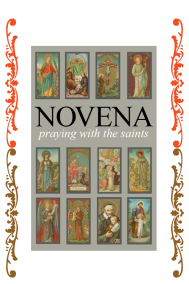
Did it have anything to do with those Holy Cards? We were big on collecting them in second grade. They were like baseball cards for Catholic girls. The gilt edged ones with Saint Theresa, Saint Cecilia, Our Lady of Fatima, all were coveted.

Which brings up a whole different thing since coveting broke the tenth commandment. We were eight years old, and all guilty.

And then there’s the pride thing. Mary Margaret Snyder had more gilt edged cards in her Missal than anyone else in the class. She held it up during Mass, ceremoniously turning to each card as the priest said his Dominus Vobiscums, his Kyrie Eleisons, his Oremuses. We sat, stood, or knelt as was prescribed, but we were watching her out of “side eyes,” elbowing each other, and hating her. Rack another one up on our confessional hit parade. Hate. It’ll take at least three Hail Mary’s plus an Act of Contrition to scrub that off.

But where I was going about those cards is, they were Da Vinci-esque renditions of martyrs who died for their faith. They were bludgeoned, or decapitated, burned at the stake, nailed upside down to a cross, tortured in a wide variety of ways. And now were featured on Holy Cards, bathed in heavenly light, eyes cast upward, heads tilted ever-so-slightly, hands outstretched or coming together in prayer.

Every so often Sister Diana introduced a new Holy Card; she’d say in soothing tones,
“Children, which martyr is this who became a saint because he/she died for Christ?”
She held the small rectangle up like Vanna White, and cut her eyes toward it with her Mona Lisa smile. We were transfixed, and determined to add it to our collections. Two guilt-edged Michael Archangels in different poses were worth a fortune. Mary Margaret Snyder held three, and wasn’t trading. So you can understand the hatred.

But the point is that I recently started thinking about the focus on “dying for Christ.” A kid takes stuff like that literally. I remember trying to figure out which way to do it−I wanted it to be quick. Decapitation, maybe? I didn’t want any Daniel in the lion’s den stuff. That would take forever.

But eventually−third grade, I think, during Lent, when they took the boys for Latin lessons−we girls were told we should “die for Christ every day;” Some of the pie eyed looks traded amongst us are legendary. Karen Flanagan wet her pants and started crying. Jesus H. Christ, people, don’t EVER speak in metaphor to anyone under eleven!

But, you know, we got over it, and life goes on. We all grew up, went our separate ways; some of us probably separated from the saints, and the church, and the rituals of holiness.

Some of us learned, eventually, that the stories told about goodness are true, and that our lives are the very celebrations, the Novenas, the prayers of righteousness for which those icons sacrificed. So some of us found our way back.

Now, listen: I’ll admit straight up that I’m a holy mess. I’m a desperate contradiction between a hunger to express my own goodness and the need to barge right in, stop the proceedings, and tell the idiots running this world a thing or two. The older I get the more I care about telling the truth, and the less it matters to me how I’m excoriated for it. That, it seems, has become my Novena.

So there’s that. Stuff. DNA; corpuscles−all laced with it. Not the only ingredient, but it’s kinda like cayenne pepper: a little goes a long way. Remember to mind the burn. It will warm you, if you let it. And it can last a lifetime.

::FAITH, HOPE, and TRUST::

FAITH HOPE TRUST 2

I’ve had several conversations lately about “Hope” and “Faith.” People ask me: are they different, or are they the same? I’ve given it a lot of thought; reflection from my seminary days. I’m going to write down some perspective I’ve had about it … mostly to clarify it in my own mind:

Faith is the element of knowing without seeing. It is the bedrock of my heart’s center, the knowing beyond understanding. We are born broken, and all long for redemption, for goodness, to finally believe we are lovable. Most of us are afraid to believe that, but it’s a critical piece on the journey to wholeness as the Father created us.

I know that my Creator’s Almighty fingerprints are all over me. I know that, in spite of my failure to always exercise “right use of will,” His plan is at work. When I feel alone, when I feel without hope, “hopeless,” it is I who have moved off center. The Creator – being truth and love – never yields, never moves. The truth is that my Father will be standing, arms outstretched, a beacon of Light, long after the noise of falsehood has collapsed under its own weight.

How can I declare this? How can I be so certain that these things are true? I have no explanation except … faith.

My parents did the best they could, but their profound brokenness saturated every thread of my childhood. Even so, it did not define it. I didn’t realize it at the time, but my childhood was defined by, and my heart was protected by, my faith.

I was born with it. In my earliest days I thought everybody was. I can remember even as a tiny girl, age two or three, looking up to the clouds, talking to the angels. No one told me they were there. I knew it. I could see them. And they saw me.

Growing up, Spirit surrounded me at some of the darkest points, when most would ask how a kid could make it through that. It was not remarkable to me. It was my “normal.” There were my parents. There was my faith. Faith was my trump card. It trumped everything. I always trusted it would be there.

And the best way I know to describe trust is, imagine a baby learning to walk. The Mama or the Daddy is right there, giving the toddler its freedom, but keeping watch in case the child starts to fall. She learns to trust that a parent will be there for her. Trust. Faith and trust. The baby is not “hoping” that someone will catch her. She moves forward on faith, “trusting” that protection is present.

Hope … hope springs eternal, but faithful hope in action is “trust.”

There are those who question the atrocities in this world, and ask how a loving God could allow such things. My answer is, we are human beings with free will, and we are each given a moral compass. Free will has a perfectly calculable algorithm called “cause and effect.” Do many people suffer from the actions of others? Without question. I believe that all the inhumanity in this world is the expression of people who are driven by their own brokenness. Happy, loving people do not have on their agenda the harming or destruction of others.

Men are not evil. Women are not suffered. We are all brokenhearted. Casting aspersions based on ANYthing – gender, race, religion, nationality … only causes us to further break our own hearts. Division helps nothing, heals nothing, takes us closer to nothing good. It carries us further into the darkness.

Satan is about separation. People often attempt to … “hope out a plan.” And I don’t think I’ve ever seen it work … in large part, because they had no faith that it would. This is a process of isolation and futility. Separation tells us to make a plan, and cross our fingers, but don’t count on it, ’cause people suck and shit happens. And with this approach, it probably will.

God is about connection. Hope-as-Trust is the fierce tangent of faith that gives us the fire to move forward smiling, in spite and in Light. When we are in sync with that Divine energy, we make plans, but remain open to the fact that it could all shift, and may even appear to fall apart so that other things can fall together. We are flexible, and willing, and openhearted. We believe that all things will work together for good.

In either case, everybody believes in something. And whatever we believe, we’re right.

The best, most radical thing we can do for ourselves and the world … is to strive to be exactly who God breathed life into at the moment of our birth. If we all, every person on the planet, would be our authentic selves for one hour, the transformation would be miraculous. Instantaneous. The world could never again return to its former state of being.

My advice, if I have any to give, is this: be brutally honest, and ultimately gentle with yourself. Let yourself have, and hold, the truths of who you are. Look deeply into your own eyes. Be tender with your own shattered places. Hold closely those parts you have a hard time embracing. Make that list of loving things you’d do for someone else, and do them for you. We love others in direct proportion to our love of the Self God created in us.

My prayer is that every person, everywhere, will ultimately bear witness to their own loveliness, their own lovability. We will discover that the peace we long for abides in us. And it’s been right there all the time.

Blog at WordPress.com.

Up ↑