::Shoeless Joe and Me::

SHOELESS JOE 2

God knows I gave my best in baseball at all times, and no man on earth can truthfully judge me otherwise.” – Shoeless Joe Jackson

I got up this morning, flipped on the TV, and discovered−happily−that Field of Dreams had just started.

Field of Dreams has to be one of my all time favorite movies. It’s about listening to that voice inside, following your gut, and discovering that the dreams you dream are often found in places and forms you least expect.

The movie centers on a family who lives on a farm in Iowa. The man−Ray−plows under a huge portion of his land and turns it into a baseball field. He goes all the way, with flood lights and bleachers. His extended family and the town community are skeptical, they say he’s lost his mind. But his wife, Annie, and his daughter, Karin, stand by him.

Ball players who’ve passed away show up on Ray’s field. But the only people who can see them are Ray, his wife Annie, and daughter Karin. The ball players are invisible to the cynics. Which only reinforces their contempt for the whole set up.

One of the ball players who shows up on Ray’s field is Shoeless Joe Jackson. That jogged my memory, and I started thinking; I knew there’d been a scandal that forced Shoeless Joe out of baseball, but what was it? What did Joe do?

So I read up on what’s called, “the Black Sox Scandal.” Joseph Jefferson “Shoeless Joe” Jackson and seven teammates on the Chicago White Sox were accused of conspiring with gamblers to throw the 1919 World Series to the Cincinnati Reds.

But here’s where it gets interesting: Joe claimed that his teammates gave his name to the gamblers even though he never agreed to participate. And the teammates admitted that Joe never attended the meetings where the fix was discussed and arranged.

There’s no debate that, during the games in question, Shoeless Joe played his ass off−throwing nothing, and hitting everything.

Joe and his teammates were acquitted following a jury trial in 1921, but newly appointed baseball commissioner Judge Kenesaw Mountain Landis barred them all from professional baseball, for life.

Jackson always claimed his innocence. He contended that teammates got him to sign a document of confession he didn’t fully understand.

That is very likely; Shoeless Joe could not read or write.

Ever since the 1921 ruling, folks have continued to fight to restore Shoeless Joe’s name.

People who knew Joe were clear: he couldn’t be guilty. Joe was the kind of guy everybody wanted as a friend. He was an honest man with a huge heart, and his love of kids was even bigger.

Today I was told that an appeal sits on the Commissioner’s desk right now, to clear Shoeless Joe Jackson from the lifetime ban. This would allow Jackson to take his rightful place in the Baseball Hall of Fame.

Many fans are waiting for word on the decision, eager to see the ban removed, and to gather in Cooperstown to at long last celebrate Shoeless Joe Jackson.

Shoeless Joe died on December 5, 1951. So he will not be present for any induction. But he lived his life, and died, knowing the truth about himself. I trust that gave him some comfort in the dark moments.

So I’m watching this amazing movie, wiping my eyes when Ray meets his departed dad, John, and thinking of my own situation.

I feel passionately for Shoeless Joe Jackson, in part because I know what it’s like to be falsely and publicly accused. And I know how, even after being declared innocent, the stain of accusation remains.

Many people you once knew as close friends look at you through that distant lens of “guilty even though proven innocent.” It is a buckling burden; a yoke I’m still getting used to.

I remind myself that the wheel turns slowly, but it does turn. Sometimes it seems like it doesn’t. But it really does.

In the movie I hear Ray’s dad, John, ask Ray,
“Is this heaven?” Ray says,
“It’s Iowa. Is there a heaven?”
“Oh, yeah. It’s where dreams come true.” Ray responds,
“Maybe this is heaven.”

I muffle a sob, and remind myself that it all evens out in the end.

And if Shoeless Joe could bear up under all that till he finally reached his own Field of Dreams − I will, too.


::TRUTH LIVES HERE::

Hand World

Truth is something I think most claim to be aligned with. Many people swear they are always on a quest for truth. But I wonder: does anyone know what they’re saying? And if they do, do they really mean what they say?

I go through deliberate periods of brutal self-examination. I’ll confess, I don’t do it as often as I should. But when I’m in the process of it, I have a “no bullshit” rule; I force myself to face the true things about me and how I view life. It’s not fun. It can be exhausting, and humbling. But to live authentically, or “in truth,” isn’t it crucial? For me, the answer is yes.

I think we want to believe we are who we claim to be. But pretty much always, in many ways (sometimes most ways) we’re just not; it’s very easy to get off track and not even know it. And to not even think about that possibility.

We often choose positions and embrace opinions about things, and then “back the information in” that will support what we’ve already decided. It’s true. We all do it.

And we gravitate to others who agree, because it’s so much easier to surround ourselves with people on every strata who reaffirm our stories. … Then we can convince ourselves that what we’ve chosen to believe is authoritative; good, and noble. Being a member of such a group renders us reassuringly superior. It’s great to feel so right.

With the best of intentions, we dress our parsing, our denial, in beautiful stories … stories of bravery and justification; stories of righteousness and independence.

And yet, truth just sits there. It does not shout. It does not defend itself or try to convince. Nor does truth move, or shrink, or change, based on our opinion about it, or our unwillingness to acknowledge it.

Every night, when the darkness comes, and we lay our heads down on our pillows, that truth … that quiet, unassuming truth that lives at the center of every good thing … revisits our hearts. We know. In that deepest part, we all know.

And every night, in each of these quiet, private moments shimmers an opening; the chance to say “yes” to the rattling of our tidy preconceptions. Relaxing our hold is the willingness through which we can climb, into a world fraught with things that were, things that are; a vast universe of open-ended questions and limitless possibilities. The mysterious and miraculous are waiting for us there.

It only takes one brave, courageous moment to let it pull us out of our defensive rightness.

Just once, let’s refuse to roll over, turn our backs to it; let’s refuse to continue the nurturing of our own self contempt.

This one small choice; this different choice – when applied in enough hearts – is sure to transform this weary, broken world.

::PEACE, AND WHERE IT’S HIDING::

Woman Arms Outstretched

Y’know, I have my phases or *periods*, sort of like Picasso. Maybe we all do, I can’t really say. But mine usually include the following:

*Reflective (can get preachy, but means well);

*Outrageous (some would call this one “obnoxious with fits of long, deep laughter” … );

*Tenderhearted (the part who wants to scoop up every hurting baby/child/person);

*Pragmatic (the “let’s just get this crap done and behind us” part);

*Maria Von Trapp (the part that wants to organize all of civilization into groups, make their clothing out of drapes, and have everybody sing in three part harmony, and in rounds)… I’m sure there are others, these are just the ones I could think of off the top of my head.

And so … *FAIR WARNING* … I’m in *reflective* mode today, and have been thinkin about this for awhile now:

When all’s said and done, I truly believe that all people, everywhere, want fundamentally the same thing. We all want to be loved, to be heard, to feel like our presence on earth matters. We all want to be safe, to live a happy and a peaceful life; we long to use our gifts to express our celebration of life.

When asked what they want, many celebrities state that they want an end to war, to have peace in the land. They speak for us all, really. We all want that. But I believe that we are blinded to the path that will lead us there. We have come to believe, many of us, that governments, or ideologies, will “give us” that. That if we vote for the right political candidates, they will bring this peace about. They, quite simply, cannot. But here’s the interesting truth:
They don’t have to “give” this to us. We already have it.

See, here’s the deal: Inside each of us, buried deeply at our core, beneath the belief of our absolute unworthiness, in there snuggled up next to our burgeoning self-contempt … there lives our truth: a thriving, pulsating, everlasting *light* … the very light we crave shines and waits inside of us; it was restored to perfection by our Redeemer’s purchase. But we live our lives in shadowy darkness, as if the gift was never given; like it never arrived.

And let me tell ya, the ego has worked one heck of an insidious job, convincing us that it is noble when we beat our breasts and declare our own revolting state. This is a self-manifesting prophecy … and it is the one that breeds envy, resentment, covetousness, greed, anger, jealousy … all the “deadlies” (and they are fatal) … ultimately the sense that we must “fight for what is rightfully mine.” This all comes from that seed of “lack.” These elements are at the center of every war, every murder, every scam, every betrayal … every corrupt company, government; every violation of real peace comes from fundamental self contempt.

And notice this: the beliefs we hold about ourselves are reflected perfectly in how we treat others. It can be no other way. When you see someone behaving negatively to others, or when you see someone relating with gentle kindness, think about that one. *Profound* truth.

It is the brave Spirit who awakens to their own authenticity and is willing, in the midst of naysayers, to reveal that to the world.

And it will continue to be a brave thing, until it is not. Until enough people start digging internally, determined to live a “self-examined life.” Then it will become the *norm*, and we will have returned to the Garden. But we go there by conscious choice, and one by one.

May each individual find the courage to *live* from their Spirit.
This is how we will change the world. ~ ♥ ~

::TEAMWORK, MA WELP, and the RADIO FLYER::

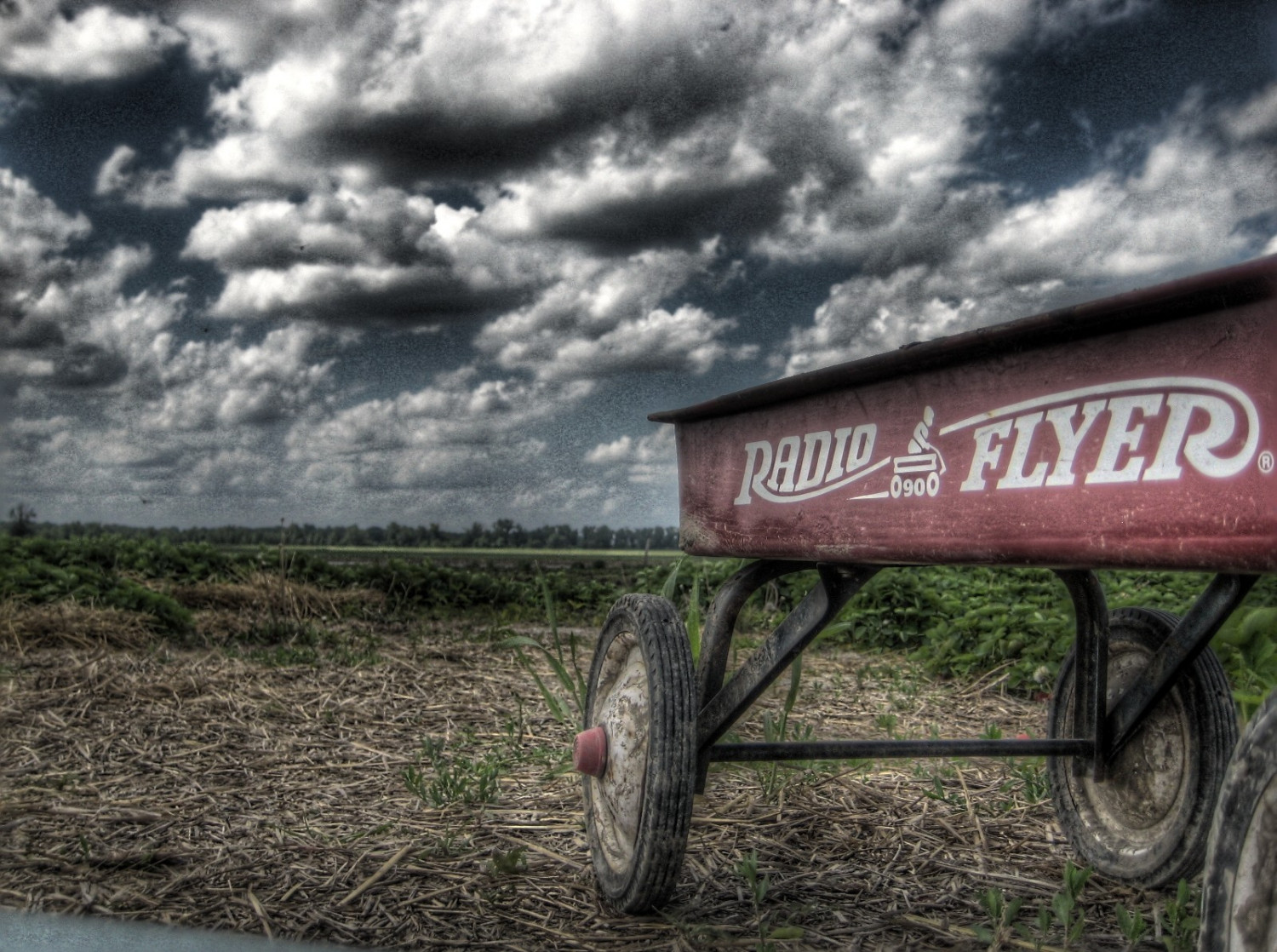
RADIO FLYER 1

Daddy said Ma Welp got her teeth from a Sears catalog. We believed him. If you could see those teeth, you’d believe him, too.

Ma was a thick bodied woman with a tight grey bun and sensible shoes. She was the babysitter when our grandmother, “Mom,” wasn’t available.

When Mom came over, once the parents were gone, she would say, “You kids go to bed now.” Then she’d settle herself down in front of Gunsmoke and fall asleep.

Ma Welp never slept. And pretty much never smiled; on the rare occasion when she did the gums on those teeth shined like new Silly Putty.

I don’t remember Ma being mean to us, but I do remember my brother and I did our best to stay out of her way. The woman was square shouldered; she could fill a doorway. She was backlit.

Ma’s daughter Tootie and our mother were best friends. Tootie was a professional golfer and had curly red hair. She was long and slim with freckles across her nose.

Tootie was always laughing. As a kid I was puzzled about how big, solid Ma Welp could be the mother of lythe, bubbly Tootie. I guess Ma’s no-nonsense way is why our parents considered her the best “number 2” on the short list of sitters.

Late one afternoon my brother and I decided to make a racecar, which we did fairly often. We walked down to Brinlee’s grocery store on the corner, and hauled back a cardboard shipping box from Rainbow Bread. The box fit snugly in our Radio Flyer. We wedged it in, and gathered our tools: an old paring knife, and crayons.

We’d done a pretty good job of carving out the opening for the driver when we heard Dad through the kitchen window.

“Okay, Ma, I’ll be by to pick you up in about twenty minutes.” We stared at each other. Awe, dammit. Ma Welp? Tonight?

“We better work really fast,” my brother said.

“We haven’t done the doors, or the lights. We’ll never get it done in time!”

“Well, we could just cut the doors,” he said, and began feverishly sawing on the cardboard.

“NO!” I hissed. “You can’t open the doors without handles and we have to put lights on it.”

“If we just cut the doors …” he had sawed about halfway through on his side. “Then we could take it to the top of the hill and ONE person could get a ride.”
I stopped drawing the headlamp and glared at him. I knew exactly where this was going.

“And who is the ONE that will ride?”

He finished cutting the door, then stood there, plucking cardboard shreds from the knife.

“Hmmm … weeell,” he said slowly as he tested his door. He threw me a sideways glance. “Y’know, racecar drivers ARE boys, so …”

“YOU are stupid!! That’s a stupid answer. And you smell like Cheerios and baloney. Racecar drivers do NOT smell like that.” I threw down my crayon. “I’m not doing this anymore.”

He put down the knife and, without looking at me, picked up the tongue of the wagon.

“Okay. Bye-bye.”

He pulled our race car through the gate, down the driveway, and headed up the hill. I went down the driveway and watched him reach the top. I saw him climb in our race car, give it a shove, and head down the hill. He gained speed as he rolled, steering with the tongue. He was Mario Andretti. I hated him.

When he got to our driveway, he steered it right, and up the incline. I saw daddy coming down the street with Ma in the car, so I got behind the wagon and started pushing him up the driveway and through the gate. The wagon came to a stop back where our race car building began. He climbed out and looked at me, smiling.

“That was a great ride!” I glared at him.

“Shut up. Daddy’s back with Ma.” His face went pie eyed.

“Uh oh. We better chop chop.” We gathered our crayons, our little knife, and slipped inside. One thing we were good at doing together was making ourselves scarce. And we did that more often that we made race cars. I guess you could say we were pros at it.

:::LIFE AS A NOVENA:::

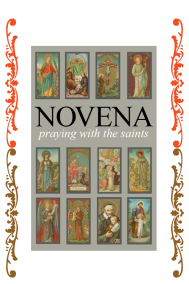
NOVENA CARD

“The more things change, the more they stay the same.” Not sure why that saying came to mind this morning, but it wouldn’t leave me alone so I wrote it down.

I’m finding myself in an interesting place. The last quarter of last year was probably the most difficult, the most challenging, in my life. I say that, then I find my gaze drifting back through the past−pregnant at twenty, hysterectomy at twenty seven, trying so hard to be all I could be to everybody−and completely missing the mark on self awareness, self care, self sustenance.

Did it have anything to do with those Holy Cards? We were big on collecting them in second grade. They were like baseball cards for Catholic girls. The gilt edged ones with Saint Theresa, Saint Cecilia, Our Lady of Fatima, all were coveted.

Which brings up a whole different thing since coveting broke the tenth commandment. We were eight years old, and all guilty.

And then there’s the pride thing. Mary Margaret Snyder had more gilt edged cards in her Missal than anyone else in the class. She held it up during Mass, ceremoniously turning to each card as the priest said his Dominus Vobiscums, his Kyrie Eleisons, his Oremuses. We sat, stood, or knelt as was prescribed, but we were watching her out of “side eyes,” elbowing each other, and hating her. Rack another one up on our confessional hit parade. Hate. It’ll take at least three Hail Mary’s plus an Act of Contrition to scrub that off.

But where I was going about those cards is, they were Da Vinci-esque renditions of martyrs who died for their faith. They were bludgeoned, or decapitated, burned at the stake, nailed upside down to a cross, tortured in a wide variety of ways. And now were featured on Holy Cards, bathed in heavenly light, eyes cast upward, heads tilted ever-so-slightly, hands outstretched or coming together in prayer.

Every so often Sister Diana introduced a new Holy Card; she’d say in soothing tones,
“Children, which martyr is this who became a saint because he/she died for Christ?”
She held the small rectangle up like Vanna White, and cut her eyes toward it with her Mona Lisa smile. We were transfixed, and determined to add it to our collections. Two guilt-edged Michael Archangels in different poses were worth a fortune. Mary Margaret Snyder held three, and wasn’t trading. So you can understand the hatred.

But the point is that I recently started thinking about the focus on “dying for Christ.” A kid takes stuff like that literally. I remember trying to figure out which way to do it−I wanted it to be quick. Decapitation, maybe? I didn’t want any Daniel in the lion’s den stuff. That would take forever.

But eventually−third grade, I think, during Lent, when they took the boys for Latin lessons−we girls were told we should “die for Christ every day;” Some of the pie eyed looks traded amongst us are legendary. Karen Flanagan wet her pants and started crying. Jesus H. Christ, people, don’t EVER speak in metaphor to anyone under eleven!

But, you know, we got over it, and life goes on. We all grew up, went our separate ways; some of us probably separated from the saints, and the church, and the rituals of holiness.

Some of us learned, eventually, that the stories told about goodness are true, and that our lives are the very celebrations, the Novenas, the prayers of righteousness for which those icons sacrificed. So some of us found our way back.

Now, listen: I’ll admit straight up that I’m a holy mess. I’m a desperate contradiction between a hunger to express my own goodness and the need to barge right in, stop the proceedings, and tell the idiots running this world a thing or two. The older I get the more I care about telling the truth, and the less it matters to me how I’m excoriated for it. That, it seems, has become my Novena.

So there’s that. Stuff. DNA; corpuscles−all laced with it. Not the only ingredient, but it’s kinda like cayenne pepper: a little goes a long way. Remember to mind the burn. It will warm you, if you let it. And it can last a lifetime.

::FAITH, HOPE, and TRUST::

FAITH HOPE TRUST 2

I’ve had several conversations lately about “Hope” and “Faith.” People ask me: are they different, or are they the same? I’ve given it a lot of thought; reflection from my seminary days. I’m going to write down some perspective I’ve had about it … mostly to clarify it in my own mind:

Faith is the element of knowing without seeing. It is the bedrock of my heart’s center, the knowing beyond understanding. We are born broken, and all long for redemption, for goodness, to finally believe we are lovable. Most of us are afraid to believe that, but it’s a critical piece on the journey to wholeness as the Father created us.

I know that my Creator’s Almighty fingerprints are all over me. I know that, in spite of my failure to always exercise “right use of will,” His plan is at work. When I feel alone, when I feel without hope, “hopeless,” it is I who have moved off center. The Creator – being truth and love – never yields, never moves. The truth is that my Father will be standing, arms outstretched, a beacon of Light, long after the noise of falsehood has collapsed under its own weight.

How can I declare this? How can I be so certain that these things are true? I have no explanation except … faith.

My parents did the best they could, but their profound brokenness saturated every thread of my childhood. Even so, it did not define it. I didn’t realize it at the time, but my childhood was defined by, and my heart was protected by, my faith.

I was born with it. In my earliest days I thought everybody was. I can remember even as a tiny girl, age two or three, looking up to the clouds, talking to the angels. No one told me they were there. I knew it. I could see them. And they saw me.

Growing up, Spirit surrounded me at some of the darkest points, when most would ask how a kid could make it through that. It was not remarkable to me. It was my “normal.” There were my parents. There was my faith. Faith was my trump card. It trumped everything. I always trusted it would be there.

And the best way I know to describe trust is, imagine a baby learning to walk. The Mama or the Daddy is right there, giving the toddler its freedom, but keeping watch in case the child starts to fall. She learns to trust that a parent will be there for her. Trust. Faith and trust. The baby is not “hoping” that someone will catch her. She moves forward on faith, “trusting” that protection is present.

Hope … hope springs eternal, but faithful hope in action is “trust.”

There are those who question the atrocities in this world, and ask how a loving God could allow such things. My answer is, we are human beings with free will, and we are each given a moral compass. Free will has a perfectly calculable algorithm called “cause and effect.” Do many people suffer from the actions of others? Without question. I believe that all the inhumanity in this world is the expression of people who are driven by their own brokenness. Happy, loving people do not have on their agenda the harming or destruction of others.

Men are not evil. Women are not suffered. We are all brokenhearted. Casting aspersions based on ANYthing – gender, race, religion, nationality … only causes us to further break our own hearts. Division helps nothing, heals nothing, takes us closer to nothing good. It carries us further into the darkness.

Satan is about separation. People often attempt to … “hope out a plan.” And I don’t think I’ve ever seen it work … in large part, because they had no faith that it would. This is a process of isolation and futility. Separation tells us to make a plan, and cross our fingers, but don’t count on it, ’cause people suck and shit happens. And with this approach, it probably will.

God is about connection. Hope-as-Trust is the fierce tangent of faith that gives us the fire to move forward smiling, in spite and in Light. When we are in sync with that Divine energy, we make plans, but remain open to the fact that it could all shift, and may even appear to fall apart so that other things can fall together. We are flexible, and willing, and openhearted. We believe that all things will work together for good.

In either case, everybody believes in something. And whatever we believe, we’re right.

The best, most radical thing we can do for ourselves and the world … is to strive to be exactly who God breathed life into at the moment of our birth. If we all, every person on the planet, would be our authentic selves for one hour, the transformation would be miraculous. Instantaneous. The world could never again return to its former state of being.

My advice, if I have any to give, is this: be brutally honest, and ultimately gentle with yourself. Let yourself have, and hold, the truths of who you are. Look deeply into your own eyes. Be tender with your own shattered places. Hold closely those parts you have a hard time embracing. Make that list of loving things you’d do for someone else, and do them for you. We love others in direct proportion to our love of the Self God created in us.

My prayer is that every person, everywhere, will ultimately bear witness to their own loveliness, their own lovability. We will discover that the peace we long for abides in us. And it’s been right there all the time.

::JOURNAL ENTRY: OCTOBER, 1961::

Tattered Treasure Box

My altar is secret. I don’t really even have one yet, but I’m getting ready.The things I have for it are tucked away in a box. It’s a shoebox. From Renberg’s. Christmas, 1959. My father’s slippers came in it. If I lower my nose to the box, I can still smell the leather from those slippers.

The box is in the bottom drawer with some other stuff—so that no one can tell it’s something special.

A picture of Susan Van Wyck is in there. Susan Van Wyck’s been on the cover of Seventeen magazine about twenty times. Some people tell me I look like Susan Van Wyck. But she’s so beautiful, it makes me shy to think about it; I can’t believe it. But I keep that picture to remind me.

Then there’s my scapular. I got it in first grade when I made my First Holy Communion. It’s faded and the silk straps are twisted, but it reminds me of the Holy Sacrament. I like to remember when I was seven, and believed everything they told me, without question. Sometimes I sleep with it on, because I need those feelings I had back then. Innocent. Faithful.

There’s a little rock from the time we went to Roman Nose State Park. It was the summer before first grade, and the only vacation we ever took. This stone makes me think of highways, and swimming pools, and places far away.

The four leaf clover is from my boyfriend. Rick gave it to me –or should I say he walked down the aisle at school and dropped it on my desk. That’s how I knew he was my boyfriend. We haven’t talked to each other or anything, but sometimes you just know.

The scrap of brown eyelet material is from Nanny. She taught me how to sew, starting when I was five. When I was ten, She taught me to use the treadle machine on her patio. We made doll clothes all summer that year. Nanny always said, “You can do anything you want to do. Just come up with an idea, then think backwards and you’ll know how to get there.” This piece of fabric reminds me that I can do anything.

The last thing in here is a crystal heart. Daddy gave it to me before the 8th grade dance. It’s the prettiest thing I’ve ever seen, and it makes my own heart squeeze when I look at it. When Daddy’s having a bad night and I can hear him through my door, I take the crystal heart out and put it under my pillow. It helps me remember who he really is.

::TULSA, OKLAHOMA::

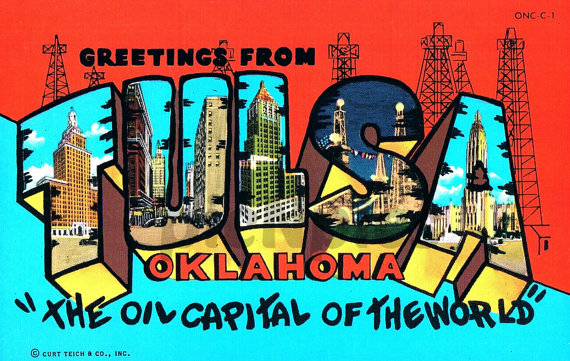
TULSA POSTCARD

I grew up in Tulsa, Oklahoma
Where you learn that the Trail of Tears was real, stopped in Tahlequah, and never really ended.

I grew up in Tulsa, Oklahoma
Where you learn that even half a can of Aqua Net cannot hold sway against the wind.

I grew up in Tulsa, Oklahoma
Where you learn that the kindness you seek at home is given by the ladies at Bishop’s Bakery, Tuesday afternoons on your way home from school.

I grew up in Tulsa, Oklahoma
Where you learn that, on a clear day, you can see the state line in all directions.

I grew up in Tulsa, Oklahoma
Where you learn what love is. And what it is not.

I grew up in Tulsa, Oklahoma
Where you learn that basements in a storm can be salvation.

I grew up in Tulsa, Oklahoma
Where you learn that having a dream, making a plan, and hatching a plot may be the only way out.

::WHITE HORSE::

White Horse

I shall ride a white horse
when I come to free you
although you may be sleeping
you’ll know when I arrive.

Members at your table
in profound agreement
the time is now at hand
for the best of you to rise.

Don’t reinforce your fortress
don’t gird yourself for war
the light, the love I bring you
are what you’ve hungered for.

When you turn to greet me
take a quiet moment
although it may be blinding
look into my eyes.

I am your reflection
I live there inside you
you will recognize me
the elder and the child.

Yours is a noble journey
and when at last you’ve found
the secret of the spirit
You’ll stand on higher ground.
©1994

::REACHING OUT, REACHING BACK::

Hands Not Holding

Recently someone expressed upset over trying repeatedly to connect with a friend … and the friend was not responding. She wondered what was going on; she felt hurt by the person’s silence.
Basically, what I told her is this:

I know that it’s disheartening and disappointing … sometimes even heartbreaking … when that happens. We reach out to someone we know and we love … and they don’t reach back. The silence is confusing, painful … and it feels so personal.

In the ‘pastoral counseling’ practicum I did in Seminary, there was a statement we were taught to employ:
“Unless you tell me otherwise, I am going to assume that what’s going on with you has nothing to do with me.”

It’s a good tool to use … I recommend it often, and I say it to myself when I’m in situations like this. It’s easy to start searching in my head for what it is I could’ve done wrong; otherwise, why would they be avoiding me?

But in my sane moments, here’s what I know:
Most people are so busy battling their own demons, they are completely blind to what the people around them experience when they fail to respond. And really, there is no way to know what others have going on; they could be dealing with a death, or an accident, or the typical drama we all face every day just being here on the planet.

Their situations – whatever they might be – and the apparent lack of awareness to our feelings – always call for us to extend tender hearts; mercy, and grace. And let’s be gentle with ourselves as well; it’s truly not about us.

Maybe the other person’s conduct or choices will not allow us to be around them … but we can love them from afar, and hold them in prayer.

I’ve found that it’s when we are at our most unlovable … that we need love the most. It was true for my children, and it’s true for all of us.

“Strive to be understanding, rather than be understood.”

That’s another one we learned in Seminary. It’s sound advice, and something I always try to remember.

Take a deep breath; take three … and wrap your arms around yourself. You are loved. And not forgotten.

May we all be compelled to love without condition … and if, ultimately, we get the sense it’s time to move on, may we do what is necessary; what is best … guided by our tender, compassionate hearts.

Not sure any of this helps, but I hope it does. ♥

Blog at WordPress.com.

Up ↑