::MYSTERIES OF MAMA::

Mama, Close Up

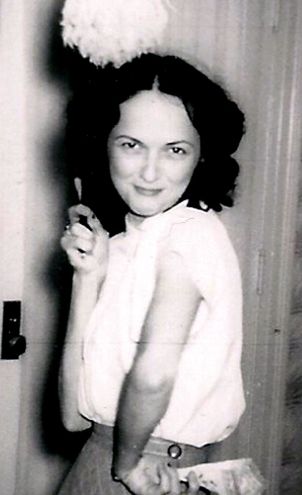
This picture was taken when we lived on South Madison. In it Mama is her beautiful, comical, musical self. Back then she would strike a pose, then collapse in laughter. She had flair, a free spirit,  she was my personal movie star, even before I knew what movie stars were.

I’ve gone back and looked through as many events as I can remember, trying to piece things together.

I’m searching for the turning point. To find when things changed. When the sun stopped shining, and the world went from bright colors to shades of grey.

I remember we had moved to the little house on North Marion. The one with the crayon blue linoleum floor. I remember a pivotal darkness, but nothing will speak to me from there. I try to go inside that space, but it’s always …. like the memories in it are right on the tip of my brain. I can almost see them. But not enough to grab hold, and to understand.

The things I know are that they had friends back then. At night they would get dressed up and go out together, and leave me with Ma Welp. But what else was happening?
I remember kitchen cabinets, with the doors open. Mama’s friend was rearranging. I remember Mama crying, and putting things back in the right places after the friend left. It was during that time that she stopped laughing.

I remember the priest coming. I remember feeling confused, and then it fades to black.
After whatever happened, that friend who was changing Mama’s kitchen never came over anymore.

Years later, when she was into her cups and in the mood to offer sage advice, she would say that you should never let anyone into your life because they’ll just walk in like they own the place and take over everything. Never get too close to anyone, she said. That’s the only way you can be safe, she said.

I’ve always wondered if that was the philosophy she used through the years to stay so far away from me. We’re closer now than ever before because, at 92, she has no clue who I am. It is a brokenhearted comfort that she always says she’d “love to get to know you.” I’d like to get to know you too, Mama. Or at least to understand what happened that kept us separate. But whatever it was, I loved you so; I choose to know that you loved me.I’m reminded of Birdie’s mother saying,

“All mothers love their daughters, even if they show it poorly.”

::THE GANG’S ALL HERE::

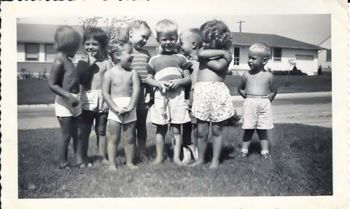
Celia and her buddies

If three year olds can be gang members, I was one. We had a pack of kids in our neighborhood on North Marion Street. Each morning, as early as any parent would allow, a youngster  drifted out the front door of his little clapboard house, and stood in the yard wearing nothing but a pair of rumpled camp shorts. Maybe he’d wander the length of  the driveway, bend down, pick up a rock, survey the street for signs of life, and head back to sit on his porch stoop. And wait.

Almost immediately, sets of young eyes threw quick glances out picture windows. Front doors opened, and small, tan feet ran or skipped or sauntered to assemble where the child was planted.

Thinking back, it gives new meaning to “the gang’s all here.” But we were.  The men in our gang wore shorts; the women, bloomers. We were brown as biscuits, the soles of our feet  well seasoned from weeks of running around bare.

We played all day, moving in a raggedy clump from one yard to another. Bill’s dad had left the hosepipe hooked up on the front spigot, so we all ran over because Shorty and Margo were thirsty. Mitchell and Bobby turned the handle, and the water spurted out. It went quickly from hot as fire to so clear and cold that suddenly we were all thirsty. Everybody got a chance. About eight or ten three year olds bending over spouting water, slurping it down their throats and bellies, all of us clamoring for more.

I don’t remember every name from back then, but I remember that water.  It started in Lake Spavinaw, and came pouring out of that front yard hose icy and sweet, flavored with a touch of rubber hose and a dash of brass metal. We all loved it, and kept drinking until Bill’s mother came out on the porch to shake the dustmop and caught us.

“You kids turn that water off and go play!” she hollered. She gave us the hard eye till Bill went over and cranked the handle.  By that time we were soaked, but we didn’t care. In fact, we liked it. It was 90 degrees in the Oklahoma shade, which there wasn’t much of.

Our gang lasted till we all started school, then life its own self took over and we drifted into our separate worlds. But if anyone ever asks me about gang membership, I can tell them, quite honestly, that I was a gang member very early on. And I’m proud of it.

::MAYBE::

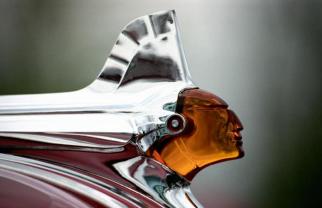
Pontiac Hood Ornament

Things in my life are the way they are, based on every choice I’ve made. They laid a road, end to end, that brought me here to this table today. Good or bad, for better or worse, here I sit; my greasy hair under a ball cap, my thoughts scattered and the censor in my brain telling me that what I’m writing now is not worth a damn.

I get sick of hearing my own voice tell my own stories. Are other people as sick of it as I am?  I don’t want to write cute, or clever. As Hemingway says, write real, about what hurts. I’ve kerfed around the edges of the pain for years, never hitting it dead center. I guess that’s real if you’re digging a trench, but I’m sort of stuck down here, looking for truth. And trying to dig my way out.

I could write about birds. But then my brain goes to the parakeet we had at 1135 South Quaker. My mother named it Perry Como. He was blue, with black wing tips, and a spot of lime green between his eyes. Thinking of him now I can smell his birdseed and that cage with the newspapers in the bottom.

When they let Perry out of that cage, he flew up and sat on the curtain rods. Every time he flew his wings made a loud flapping sound that scared my little brother.

Sometimes my mother would open Perry’s cage door, and wait. When my brother came walking through the livingroom, suddenly Perry would swoop down. My brother would scream and dive under the table, clutching the legs and sobbing. My mother raised her eyebrows, took a drag off her cigarette, and laughed. That taught me some pretty twisted things about how people treat those they claim to love. So yeah … count that little nugget as a lob to the center of the pain from the trenches.

Or maybe I could write about being a teenager. And dating.

Maybe I could write about the night a boy came to pick me up, and he had a long fringe of bangs. My little sisters peaked around the door giggling, “It’s a Beatle!” My Dad growled, “Is that your hair, boy, or is that a wig?”

Or I could write about another time my date arrived to take me to the school dance. He drove his car, parked, and my Dad drove us to school in our ’51 two door Pontiac. The two door thing is relevant because my date and my Dad sat in the front, I climbed into the back. In my formal. The thing I’ll never forget is the hood ornament. It was a glowing orange Indian Chief. I locked my eyes on that thing all the way to school, trying to ignore the awkward silence.

Maybe I could write about the faith, and the sense of humor, that have carried me on angel wings through the darkest of days, the brokenest of hearts. How, even in those moments … my date with the Beatles hair, me sitting in the back seat of that car … even then, in the recesses of my mind, I knew: “this is the rich stuff of which stories are made. I will write about this one day.”

Maybe today, sitting here at this table, wearing my ballcap, is that time.


::Right or Wrong::

right-or-wrong imageThe messages we’re given in childhood are powerful. Until we get out into the world on our own, they define our reality. They define our normal. They tell us what’s expected of us, and what value we have. And behind those front doors, each family has its own brand of ‘normal’.

I was raised in a house where there was one right way to do everything. Often I discovered there was a right way after I’d done something the wrong way. Mattered not if I accomplished my goal. If I didn’t do it the right way, I got it wrong. And that “right” way could change without warning; I learned that early on. So, go ahead, knock yourself out. But don’t count on anything except maybe being blindsided by a new rule, a new way of you failing again.

This is a piece of the legacy inherited by a child of alcoholics. Eventually, once we’ve reached adulthood and if we’re aware enough and brave enough to launch the quest for self discovery, we catch a glimpse of how life is defined outside the hazed cocoon in which we grew up; the only “normal” we’ve ever known. So there’s an overriding sense of betrayal, or having been lied to about ‘what’s going on out there’, ‘how I fit in the world,’ or even ‘who I am’. And, at its center, ‘what love feels like’.

That’s not to say that drinkers are evil. They’re not. I truly believe that very person, in one way or another, is ‘trying to find their way’. But some people get so off track; are so myopic as to what they’re doing and the damage caused by it, that they’re pretty much a walking (or stumbling) wrecking ball.

I’ll admit there are certainly things ingrained in me from my childhood that I treasure. I have a very well calibrated moral compass. I’m not an angel by any stretch, but when I’ve veered off course, I know it.

This comes from a Spiritually driven center that was awakened in me very early on. I clung to it, and was convinced that ‘if I’m good enough’ good things will, ultimately, happen. There’s probably a piece of me that still believes it.

In Seminary we studied addiction. It was pointed out to us that addicts are “headed the wrong way down the right road.” They crave a different feeling, a different perspective. But they’ve employed chemical shortcuts to get there, which always end in failure. Because in order to keep the feelings gained from drugs or alcohol, you have to stay drugged or drunk. The process is deeply and heartbreakingly flawed. Those same good feelings are authentically available. But like all things of true value, we gotta do the deliberate, serious (and personal) work to ‘get there from here’.

And something else I learned  in Seminary, is that there are quite possibly as many ways to do something as there are people to do it. Not right or wrong, based on approach. When I heard that it was not like a light went on in my head; it was more like a bomb went off.

For decades I held back on doing so many things, big and small, for fear I would do them wrong. It was earth changing when, after finally trying something, and doing it my way, there was no one there to tell me how wrong I was.

Maybe I was never really wrong, after all.

::All I Am::

All I AmThere are certain things I’d never call myself. Beautiful, for example, is one. Extensively educated, at least in the formal sense of the word, is another. Lord knows I’ve learned a gracious plenty, but the really important lessons rarely happened in the classroom.

Life starts telling us who we are early on. As little ones, we’re blank slates, eager for the information. And we don’t know better than to swallow whole what adults tell us about ourselves.

When I was three years old, one of my dad’s friends, who I only knew as Cuz, called me “muscles.”

Even at that young age, it felt like a bad thing. I didn’t want muscles. I wanted blonde curls and blue eyes like my cousin Joanie.  But there I was, a sturdy little girl with black ringlets and hazel eyes. A kid who in summer turned brown as a biscuit in ten minutes flat.

On the playground at school, the nuns would cluck disapprovingly as we lined up to go back inside. “Cecelia’s voice carries. You can hear her above all the other children.”

I remember, at around ten, being at my Nanny’s house in the summer. Old lady North, who lived the next street over, would come across the alley and in the back door for coffee. I dreaded that woman.

“Myers,” she’d say to my grandmother while studying me, “I think this child is an Indian.” Then she’d reach out and take hold of  my upper arm. “She’s brown as an Indian,” she’d say. Nanny didn’t argue. She just passed the half and half, lit another Chesterfield, and changed the subject.

As innocuous as they may have been at the time, those descriptions from the grownups in my childhood delivered the bad news to my sense of self. They informed me about who I was.

And the fact that after so many years I can still go back to those moments, see those people, observe them observing me, tells me just how impactful the comments were.

It’s taken decades. But eventually and deliberately I let go of my tendency to be defined by what was said long ago. In fact, those statements serve me well now. They’ve made me pay attention.

When I talk to children, I’m purposeful with what I say to them about who they are. Because the words adults use have staying power; they will frame – for a while, or forever – how those kids feel about themselves.

And when they think back, I want to have contributed tender words about their own beautiful truths.

::Check Please::

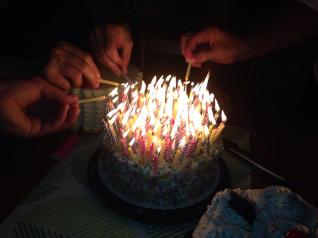
BIRTHDAY CAKE


Birthdays are interesting benchmarks. They roll around on the same date, year after year. As a kid, I generally looked forward to them. It meant “something” would happen; in the earliest years there were celebrations with cake.

Birthday number one was The Event. As the first-and-at-that-point-only child, family gathered round. Photographer Wilmot Dahlem was summoned.

I was put in the highchair, a cake was placed in front of me. I reached for the single candle and literally remember being told, “Nono, don’t touch that.” So, I did what any thinking one-year-old would do: I picked it up with my mouth.

FIRST BIRTHDAYWilmot documented the moment

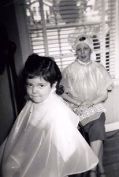
The next Birthday I remember is number three. I had a baby brother by then. That’s also the year I found Mama’s scissors when I was supposed to be taking a nap; I cut half my long hair off. Mama documented that one. The expression on that lady’s face tells the story.Celia In the Chair

My grandmother (Nanny) crocheted me a dress, with hat and purse for my Birthday that year. Wilmot took pictures of me in my dress.The short curls peaking out from under the crocheted hat … made my Mama cry.Celia at 3 - 2

As I got older and the number of siblings grew, it became more of a day when — eventually — all eyes glanced at me at some point during the day with, “Hey. It’s your Birthday.” Yes, I knew. I was “waiting for sixteen.” Then, “waiting for eighteen.”

When you’re a kid, waiting and pining to be older seems to be part of the M.O. But there’s a point; a moment. There’s a place in the sequential order of annual things when a body feels the urge to say, “I’ve had quite enough. Let’s stop this now; can we?” Well, no, comes the answer. Not really. Time, and tides, are gonna roll on. The only known way of stopping is leaving. And that’s generally not what one is thinking when it crosses the mind, on some advanced Birthday, to say, “Check please.”

I had such a Birthday yesterday. I felt full ready to call for the check … until a guy at the grocery store started chatting with me. I was standing in the aisle with the motor oil, and reached for the 5 W30 ‘high mileage’. The young man (and I say young because, at this point in my life, isn’t everyon else?) asked me a question about my car. I did a little fake laugh and told him my car needs the OCV replaced. That stopped him for a second; a woman who knows what an oil control valve is … rare bird. Then he complimented me on my sweater. Oy. I could see where this was going; I felt my face flush. I couldn’t look him in the eye. But I knew he had to have been born some year after my children. Holy crap. Nope. Moving on.

I grabbed the jug of oil, mumbled “Have a good night,” and went to self check out. I spied him heading toward the produce section, and was able to get a good look at him. Damnation; he was tall, a bit swarthy, he must work out. He was eye candy-ish … in a much-too-young-for-me-but-god-help-us-all-look-at-you sort of way.

I paid for my oil, walked out to my car, got in, and sat there for a minute. Just breathing. I considered how old I ‘am’ compared to how old I ‘feel’ … and pulled out of the parking lot thinking maybe, just maybe, I don’t need the check after all.

::I See A Giraffe::


Giraffe Blotch


I see a giraffe.  Big quiet eyes. Ears just so. Soft little horns. I can’t see his long neck. I know it’s there, beyond the card.

His neck that stretches high into the trees, so he can nibble on the tippy toppest leaves.

He’s a likeable giraffe. Loveable, even. But it’s hard to know that. His head is so very high up, one can barely look into his eyes to see his personality.

And it’s quite difficult to kiss a giraffe. The process goes thus:

You stand by the tree trunk, look up into the leaves, and you shout, very loudly,

“Mr. giraffe, I would so love to kiss you.” You hope he hears you. His head is buried up there in the tree, and you hear munching. You shout again, louder:

“Mr. Giraffe, I would really very much love to kiss you.” Still, no response. Munch munch. Try again. In fact, this time, try a slight English accent:

“Hiya, Mr. giraffe. Seems I’ve a kiss here wif your name on it. What say you, good sir?” You wait. He eats. You sigh.  You walk away from the tree, to the sidewalk. You don’t see one sly eyeball peak at you through tree leaves.

You stand on the sidewalk, looking at the giraffe … you study his spindly legs, his switching tail, his long, long neck. You suck in as much air as you can hold, and you shout out. the loudest of your louds one last time. Oh, and the English accent has become quite thick:

“Mr. giraffe, is a bloke allowed to plant a kiss on your jaw at any point in time?”  After waiting for what seems like forever but was really about a minute and a half, you shout, “Crikey!” as you turn and walk across the street. This, you decide, will never work.

“Uh. Excuse me.” You turn, and look. The giraffe is looking right at you. “Were you talking to me?”

“I … I would very much love to kiss you.” You’re on the opposite side of the street by now, but you start walking back toward the giraffe when he bellows,
“STOP!” You stop. “Back up!” You step backwards and  onto the opposing sidewalk. “Wait.” You stand and stare. You wait.

The giraffe himself backs up, away from the tree. He swivels his head around on top of his neck. Then, ever so slowly, his neck bends down. Down. Down. He brings his neck down till it stretches across that street and he is face to face with you. You can feel his soft giraffe breath.

He leans toward your ear and whispers,

“You may kiss me now.”


::Every Little Piece::


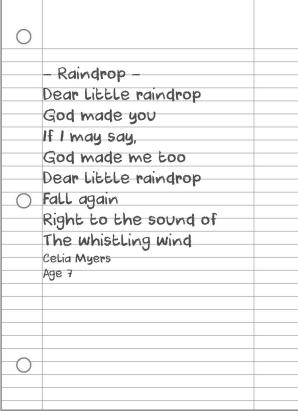
Raindrop


People always ask me when I started to write.  Especially songwriting.

I can think of points along my childhood and teen years, when I wrote to process feelings or moments; heartbreak. Confusion. Boys. But the truth is I’ve always, as long as I can remember, written it down.

I say that, and it strikes me quite odd that a tiny girl, not exposed to literary pursuits, would even think of writing.

I was a post war baby; my mother and daddy were young, beautiful, hard working. My daddy was a Navy man, and knew how to do just about everything. They were musical, and funny, but they were not the type to bury themselves in Tolstoy or Hemmingway. They had better things to do: roll up the rug in the dining room on Saturday afternoon and dance to Benny Goodman and Kay Starr records. Or sit on the front stoop at sunset, leaning into each other, beer in hand, and watch the kids ride their trikes in the driveway.

So how did I end up here, at this keyboard? Or way back there, at that Big Chief tablet with my Dixon Laddie #304?

I remember a moment when I was five. I was sitting on the swing in the back yard at 1563 North Marion. The sky was so blue, and I was so happy, I wanted to write a song about how I felt. I threw my head back, and instead of words coming out, I cried. My happy went heartbroken in that moment; I wept, because I knew I was too little to write a song that sounded like the ones on the radio.

And it’s interesting, isn’t it? How I remember that moment so clearly. How even as I think about it, I am “back there,” under that blue sky. In that back yard on that swing. My stomach even grabs for a second as the feelings I had then are here with me now.

So I guess you could say the writing thing has always been part of what I am. I remember in first grade, Sister Dianna was teaching us a song, and I was saying the words with her. She stopped, looked at me, and said,

“Mary Cecelia, do you know this song already?” No, I didn’t. I’d never heard it before. But somehow, I knew what would come next in the lyrics. Didn’t everybody? No, it turns out. They didn’t.

In third grade, Sister Mary Damien announced that the Highschool newspaper class was asking for poems from the grade school. They were going to publish one poem in the next edition of their paper. We were to turn our poems in the next day. My hear jumped, and my head started spinning with the tomes I would write.

That night at home, I took out my Big Chief tablet and my Laddie pencil, and I wrote. I wrote at least a half dozen one-stanza poems. I gave each stanza a name, and its own sheet of lined paper. I made the pages as neat as my third grade southpaw printing could get.

The next morning, I shuffled into the classroom with my classmates, laid my stack of poems on the corner of Sister’s desk, and took my seat. I watched her eagerly, hoping she would be proud of me.

Finally, Sister Damien walked over to her desk and picked up my pages. She leafed through them, then ripped them in half and threw them in the waste basket. As she did so she looked up at me briefly and stated,

“You were not to copy out of a book.”

My stomach lurched. My face turned hot. My eyes welled up. I was horrified, for several reasons:

First, it would never have crossed my mind to turn in someone else’s work; the fact that she thought I would do such a thing made me want to cry.

Second, even at seven years of age, I was in a panic: those were the only copies I had. I learned an important lesson that day: always make duplicates.

Third, though my classmates were laughing at me, I was more concerned with people thinking I had such a flawed moral compass. They clearly didn’t know me at all.

On another level, buried deep beneath my chaotic feelings, was a little voice that whispered,
“Hmmm. They must have been good. REALLY good. She thought you copied them out of a book.”

A backhanded compliment from a nun, saying my work was so good I could not have done it. I’ve lived a lifetime of twisted victories like that.

In fourth grade, we had music class two mornings a week. One morning the music teacher announced that there would be a music program, and that we would be in it. She then said to the class,
“We will need someone to sing the solo. Are there any solo singers in here?”

The entire class turned, without a sound, and pointed at me. All I’d ever done was sing with everyone else.  I was completely unaware of my own voice. With all those fingers and eyes directed at me, I buried my face in my arms and cried.

Eventually I did sing the solo in the program that year. And I kept writing. There were times, big stretches in fact, when I was writing for my life. And music is the silver thread that’s always kept me tethered here.

In fact, writing and music have laced the pieces of my life together, helped me make sense of myself, this world, and the path I’m on. They still do.

I used to think maybe these things were pieces of generations past, pulling me back. But I’m starting to believe maybe they’re pieces of the future, pulling me forward.

Either way, I’ll take it. And I’ll write and sing the pieces of my life together, for as long as I’m here.



::Oh, Fitzwilliam::

Celia at 3 - 3I’m a little teary today. Not constantly, but in those spaces between big thoughts it creeps in, and I catch my breath. Really, it’s the craziest thing. It started with David Bowie. And Jane Austen.
I’m of the generation that rode Bowie’s outrageous musical wave with him. I was on the sidelines, having babies; but I watched, and listened. And dreamed.

The Viet Nam war was raging, girls were burning bras, and in California, hippies were putting daisies in the barrels of guns.

In my little world, I imagined what that  life would be like. If I could make the music I wanted to make. If I could chop my hair, turn it pink, or orange, or blue. If I could climb out of my responsible skin, and into the skin of a free spirit. Jump off the limb, way up high, believe I could fly.

And as an avid reader of Jane Austen books, I also imagined going back to those days, of handiwork under the shade tree; of a simpler life. Of Mr. Darcy.

But I was a young mother; my  beautiful babies needed feeding, wash had to be done … all the things that go into keeping a life on track. Still, while hanging diapers on the line, or cooking dinner, or folding clothes, singing lullabyes, my mind went on amazing journeys … back in time, or somewhere future. It still does.

Sometimes I’m a literary writer, sitting on the sandy beach with her books and pens. The south of France; or Italy, in a small medieval castle by the sea.  I can see that so clearly, it’s like I’m really there.

Other days I feel the need to trim the oil lamps and pull out my grandmother’s treadle sewing machine.

My fantasy world also embraces the anticipation of  relationship.

I remember as a young girl of eight going to see War and Peace. We came home and for days I wouldn’t look in the mirror; I didn’t want to break the spell that I truly was Audrey Hepburn as Natasha Rostova, pursued by the handsome Prince Andrei Bolkonsky.

Years passed, and I kept growing up, as girls do. But I continued to live my fantasies while setting the table or ironing the pillowcases. From the Philco radio, Frankie Lane sang “They Called the Wind Mariah.” It may have looked like I was just pressing hard creases on cloth table napkins, but I knew I was riding a wild Mustang across the prairie, the wind in my hair.

That was long ago. My life has seen heartbreak, death, love, more heartbreak. And yet. Yet I still dream; I still believe.

In spite of what I’ve walked through, I  know my Alan Rickman’s Colonel Brandon is waiting for me.  But the truth is, I possess the spunk and mettle of Elizabeth Bennett.

So perhaps it will be Mr. Fitzwilliam Darcy who calls for me, after all.


::Angels In The Clouds::

Lost Girl Sepia

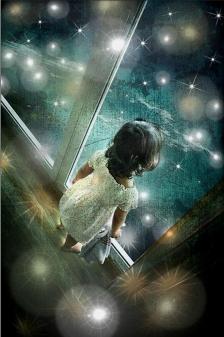
When I was a child, I could see angels in the clouds. The day I ran away from school, after the woman at the gas station took me home, I laid on my bed and watched them out the window. That was the day my Daddy dropped me off at kindergarten late again. The day Sister Isabel said late comers would get in serious trouble.

I waited till my Daddy had driven his car out of the school parking lot; then, instead of pulling open the heavy door and going inside, I turned around and walked away.

I walked my five year old self across the busy intersection. Rush hour traffic. I walked as far as the culvert leading down to the river. The one the bridge crossed over, the one where my brother sat on the floor board in the back seat and squeezed his eyes closed every time daddy drove across. That one. I sat in the tall grass, and thought to myself: where should I go now? I’m stuck. A little thread of panic made my heart jump, and for a minute I thought I might cry.

I looked over my shoulder at the Phillips Sixty Six station on the corner. There were people there, so I got up and made my way toward them. My legs were itchy from the grass, and I was getting sweaty. I tried to unbutton my coat, but I couldn’t make my fingers work right.

I stepped onto the concrete and saw a lady with a little girl sitting in their car. The filling station guy was checking her oil. I wasn’t supposed to talk to strangers, but I thought a little girl’s Mama might be okay.

I wandered closer, stopped a little ways from the car, and stared. The woman was paying the gas station man when she saw me. She sat there for a minute, then she and her little girl got out of the car and came over to me. She said,
“Honey where’s your Mama?”
“At home,” I whispered.
“Do you know your address?”
“22336.”
“I don’t think that’s an address. Is that your phone number?” I was confused; I knew it was something, I just wasn’t sure what. I dropped my head, looked up at her under my eyelashes, and sucked my finger.

She must have decided she couldn’t leave me there, so she put me in the car with her little girl. I remember thinking she smelled like flowers. Her little girl had curly hair and dimples. Her bonnet matched her coat.

She gave us each a stick of Wrigleys Spearmint, and when we got to her house the lady called my mother at 22336. She wrote down my address, then she and her little girl carried me home.

When we got there my mother thanked the woman profusely, but once the door was closed behind them, she was furious. We were Catholics, and that woman was the wife of a Protestant preacher, how could I have embarrassed her like that? She frowned, held her hand under my chin, and made me spit my gum out.

It was Mama’s laundry day; she stripped off my clothes down to my undershirt, painties, and socks. She told me to go get on my bed and stay there. The sheets were being washed, so I laid down on the mattress pad and scooched over to look out the window. That’s when I saw them. The angels. I’d seen them before. But today, more than ever, I was glad they were there. And given the adventure I’d just been through, it seems pretty clear they’d been with me all along.

Blog at WordPress.com.

Up ↑