::Becoming Real::

I was a child of the sixties, and grew up in a household centered around the Holy Catholic Church and Pabst Blue Ribbon beer. My parents were children of the Great Depression; they learned that life means do without, stretch a dollar, work hard, and drink harder. I was their first child, born to them when they were still young, tragically beautiful, and very much in love. When I was a little girl I would shyly study my mother’s face … her wide eyes, long eyelashes, full red lips. She was clearly a movie star in hiding. I wondered what she was doing in this little life, in this house on North Marion Street, with its linoleum kitchen floor and one parched sapling in the front yard. Even at five, I knew she’d been miscast. Through the years, five more babies, and alcoholic chaos, it became an undeniable fact: my mother belonged in a different movie. 

As the oldest daughter, I took on the job of laugh inducing peacemaker. Lots of oldest daughters have that role. My brother, two years younger, was mother’s tenderhearted caretaker. We spent our childhood together in the family foxhole. Nothing will bond siblings like friendly fire. It’s a sort of hellish, heartbreaking love that no one else knows. No one. But at the time, it was our family’s brand of ‘normal,’ so imagine my surprise when, years later, I learned that some families have no foxhole at all.

I lurched through the decades, reinventing myself over and over, determined to be whoever those claiming to love me told me I was. It took over forty years, and one spectacular betrayal for me to stop, and turn my attention to the whisper of truth. It was there all along, but I hadn’t heard it before, because I wasn’t ready. Not only had I become ready, I threw up the white flag of surrender. I’d run out of things to try, people to be. And I was exhausted.. All I had left was me. When I finally gave into myself, it felt like declaring bankruptcy. 

I remember the date. May 12, 1991. My attorney’s call that morning woke me up. She was calling to let me know the divorce was final. She’d used the word, “Congratulations.” I got off the phone, and laid in bed, waiting. I didn’t know what to expect, but I thought surely I would feel … something. Relief? Excitement, maybe? All I got was silence. I threw off the covers, walked into the bathroom, and stared in the mirror. I looked into my own eyes, searching for … someone. Who will I be now? I whispered. I had no idea.

Ever since I was a tiny girl, there’s been … something … like a tiny thread … woven deep inside me. Piled over with years of Catholic school, alcoholic parents, sweet babies, abusive marriage, broken dreams … you’d think that thread would have broken, or suffocated, or disintegrated. It never did. 

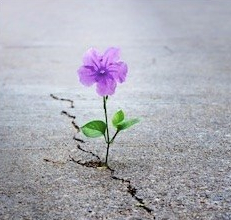
Like a flower finding its way to the sun through a crack in the stone, that shimmering little strand found its way back to me. 

The very thing I feared would be most difficult has become easy, feels natural. Coming home to myself is simple, and honest. I am moving back toward the center of someone I’ve always known. It warms my heart, settles my belly, and brings perspective into sharp focus. I know where home is now. And I see that I was right here all the time. 
::Nanny’s Back Porch::

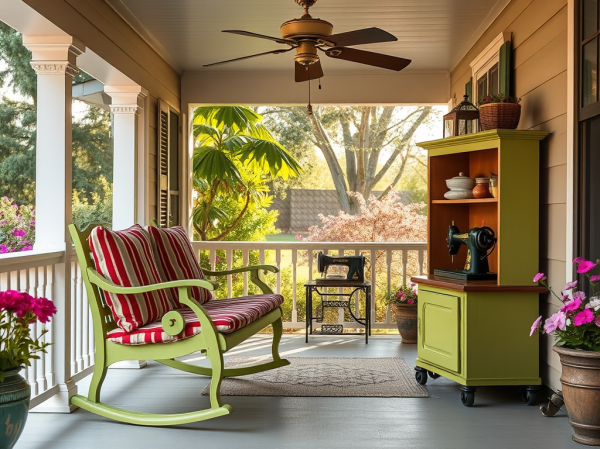
I remember the glider. The arms and frame were painted chartreuse green. The cushions were upholstered in oil cloth with wide red and white stripes.

Nanny sat on it every morning with her cup of coffee and the morning newspaper. She drank her coffee in a china cup that sat on its own saucer. There were delicate flowers hand painted on them both. She added half and half to the coffee until it looked like caramel.

I remember the treadle machine. It sat against the back wall next to the door on the the concrete patio. The patio was large, and had a lofty roof. The area was cooled with a large ceiling fan that hung from the rafters.

I remember the gentle, rhythmic sound of that fan, and the air that it created.

Nanny’s patio was a place where I knew I could do anything. It was almost sacred in that way, though I didn’t know it at the time. But every weekday morning during my ninth summer, I did my chores, then called my Nanny.

“Nanny? Can I come over?”

“Come on, baby.”

I packed my little cardboard suitcase with my doll and fabric scraps, then walked the two and a half blocks to Nanny’s house.

I remember climbing the steps leading to her house. The front porch had steps of its own. Wrought iron columns painted chartreuse on each corner. Two pink flamingos stood amongst the flowers in front.

The house wall of the porch was knotty pine. A mailbox hung on the left side of that wall. It looked like a covered wagon.

Exactly like a covered wagon.

Nanny made it.

I followed the sidewalk around the left of the house to the back. When I reached the back, I lifted the latch on the large black iron gate. It slowly rolled open, I walked into the back and pushed it shut behind me.
Nanny was there on the glider, her back to me, holding the newspaper akimbo in front of her.


When I think about it now, it makes me tear up. I didn’t know then, didn’t understand, how hungry I was for a space where I could be my unbridled creative self.
At home the message was clear: do your chores, stay out of the way, be quiet. In other words, try not to suck too bad.

But here at Nanny’s, my nine year old shoulders dropped. The knot in my stomach let go. I could sew on the treadle all day long, and nobody would stop me. If I got to a place where I needed help, Nanny was there to lend it. No criticism, no shame, just safety.

I don’t recall her ever really championing my pursuits, but she never cut me down either. I was present and a participant in many of her own creative projects and, by that, I learned that anybody could do anything they dreamt up, all they needed to do was start.

I remember Nanny’s projects where she taught me to “sand with the grain,” to “paint in long, firm but gentle strokes on furniture,” and “never buy a sewing pattern, always make your own.”

Nanny would be horrified if she could see the pile of sewing patterns in my work room today, but all she taught me … about how to do things, and about trusting myself and my creative process – are literally what have inspired me and saved me.

::Breaks My Heart::

I was so young when I had my babies. I knew only enough to keep them diapered and fed and loved. I sensed there was something deeper still in the act of loving them, but I didn’t know how to get there. I thought about that often, and it broke my heart.

As my babies were growing up, I took them to Sunday school, and to church. They learned to ride bikes, they played dominoes and Uno. They jumped off the pier in Perdido Bay. I was there as mother, but also as observer. I tried to give them all of me. But I often thought that just fell short. And it broke my heart.

They grew into teenagers. Music blared, the house filled with their friends, and sometimes we laughed till our sides ached. Good, rowdy kids who pulled on the reins. It felt like I was always scrambling to keep up but I fell behind so often, and it broke my heart.

Now as I look back on those years. I swear, it feels like a different lifetime. My babies are grown, married, and my grandbabies are almost grown. My goal, my intention, is to always be there for them. But even now, it feels like I fall short, and it breaks my heart.

She had no idea how good a job she was doing. She always felt she never measured up to what she should be. I guess love is like that … you have so much to give, you give all you have, and yet there’s a longing to give more, to be more.

Now, when I tell them how sorry I am for any wrongs I might have done them during their childhood they laugh, feign outrage, and tell me to stop.

If I could, I would live long enough to spill love on all my kids till they day they die. 

But I can’t and it breaks my heart.

So I’ll just keep doing my brokenhearted best, as long as I’m here, and hope it’s enough.

::Every Little Piece::

People often ask me when I started to write.  Especially songwriting.

I can think of points along my childhood and teen years when I wrote to process feelings or moments; heartbreak. Confusion. Boys. But the truth is I’ve always, as long as I can remember, written it down.

I say that, and it strikes me quite odd that a tiny girl, not exposed to literary pursuits, would even think of writing.

I was a post war baby; my mother and daddy were young, beautiful, hard working. My daddy was a Navy man, and knew how to do just about everything. They were musical, and funny, but they were not the type to bury themselves in Tolstoy or Hemingway. They had better things to do: roll up the rug in the dining room on Saturday afternoon and dance to Benny Goodman and Kay Starr records. Or sit on the front stoop at sunset, leaning into each other, beer in hand, and watch the kids ride their trikes in the driveway.

So how did I end up here, at this keyboard? Or way back there, at that Big Chief tablet with my Dixon Laddie #304?

I remember a moment when I was five. I was sitting on the swing in the back yard at 1563 North Marion. The sky was so blue, and I was so happy, I wanted to write a song about how I felt. I threw my head back, and instead of words coming out, I cried. My happy went heartbroken in that moment; I wept, because I knew I was too little to write a song that sounded like the ones on the radio.

And it’s interesting, isn’t it? How I remember that moment so clearly. How even as I think about it, I am “back there,” under that blue sky. In that back yard on that swing. My stomach even grabs for a second as the feelings I had then are here with me now.

So I guess you could say the writing thing has always been part of what I am. I remember in first grade, Sister Dianna was teaching us a song, and I was saying the words with her. She stopped, looked at me, and said,

“Mary Cecelia, do you know this song already?” No, I didn’t. I’d never heard it before. But somehow, I knew what would come next in the lyrics. Didn’t everybody? No, it turns out. They didn’t.

In third grade, Sister Mary Damien announced that the Highschool newspaper class was asking for poems from the grade school. They were going to publish one poem in the next edition of their paper. We were to turn our poems in the next day. My heart jumped, and my head started spinning with the tomes I would write.

That night at home, I took out my Big Chief tablet and my Laddie pencil, and I wrote. I wrote at least a half dozen one-stanza poems. I gave each stanza a name, and its own sheet of lined paper. I made the pages as neat as my third grade southpaw printing could get.

The next morning, I shuffled into the classroom with my classmates, laid my stack of poems on the corner of Sister’s desk, and took my seat. I watched her eagerly, hoping she would be proud of me.

Finally, Sister Damien walked over to her desk and picked up my pages. She leafed through them, then ripped them in half and threw them in the waste basket. As she did so she looked up at me briefly and stated,

“You were not to copy out of a book.”

My stomach lurched. My face turned hot. My eyes welled up. I was horrified, for several reasons:

First, it would never have occurred to me to turn in someone else’s work; the fact that she thought I would do such a thing made me want to cry.

Second, even at seven years of age, I was in a panic: those were the only copies I had. I learned an important lesson that day: always make duplicates.

Third, though my classmates were laughing at me, I was more concerned with people thinking I had such a flawed moral compass. They clearly didn’t know me at all.

On another level, buried deep beneath my chaotic feelings, was a little voice that whispered,
“Hmmm. They must have been good. REALLY good. She thought you copied them out of a book.”

A backhanded compliment from a nun, saying my work was so good I could not have done it. I’ve lived a lifetime of twisted victories like that.

In fourth grade, we had music class two mornings a week. One morning the music teacher announced that there would be a music program, and 

that we would be in it. She then said to the class,
“We will need someone to sing the solo. Are there any solo singers in here?”

The entire class turned, without a sound, and pointed at me. All I’d ever done was sing with everyone else.  I was completely unaware of my own voice. With all those fingers and eyes directed at me, I buried my face in my arms and cried.

Eventually I did sing the solo in the program that year. And I kept writing. There were times, big stretches in fact, when I was writing for my life. And music is the silver thread that held onto me, that’s always kept me tethered here.

Truth is, writing and music have always laced the pieces of my life together, helped me make sense of myself, this world, and the path I’m on. They still do.

I used to think maybe these things were pieces of generations past, pulling me back. But I’m starting to believe maybe they’re pieces of the future, pulling me forward.
Either way, I’ll take it. And I’ll write and sing every little piece of my life together, for as long as I’m here.

::So The Kids Will Know::

I want my kids to know.

I’ve been writing since I could hold a pencil. In my mind, even then, it’s “what you do,” isn’t it? Write. Draw. Express yourself on the page.

And I’ve done a lot of it through the years – decades, really – that I’ve been alive.

But recently I’ve been thinking about something. And that is, what will my writing tell my children about me?

I never really knew my mother. She was a cold and distant woman, and no matter how hard I tried, I could never bridge the gap. I could not reach her.

She died on October 31. Halloween. In some weird, standup comedy way, that seemed fitting. But the humor dies out and gives way to the heartbreaking fact that whoever she was will remain a mystery.

Now back to my thought about my kids. I want them to know their mother. I want them to have all the pieces, so they can more clearly understand themselves. I want them to have no questions about who I am, who I was, or why I was and am this way. They need to know.

So now we’re at the memoir. I’ve dragged my feet through a couple of decades, because a lot of the truth isn’t pretty. And on some level I kept thinking the people who treated me poorly would die, and then the book would be safe to write.

But it’s not that simple. It never is. My goal has never been to disparage anybody. My intention is to tell my story, and to share how I survived all that happened. 

I want my children to know what sturdy stock they’re made of. They need to know how, on more than one occasion, their mother “sucked it up” and carried on.

They need to know that the three-legged stool I’ve referenced all their lives – the one with the legs of faith, music, and humor – has, in very real terms, always held me up and held my life together. 

I pray for the courage to write it all. I hope that readers will see that the pattern of broken pieces of their lives is, from a distance, a stunning mosaic.

I hope people understand that the sturdy, fragile, holy, horrible, inspiring, hysterical, happy, messy lives they live are beautiful.

I hope my kids fully embrace it all; that knowing who their mama is will help them see that if I could do it, they can too.

::The Party::

I was not allowed to go. Anywhere.

Well, that’s a broad statement, too broad. I could attend school, Confession on Saturdays, Mass on Sundays. The time in between these events, when I wasn’t doing chores, I spent in my room … a small converted sunporch at the back of the house.

My bed was a chair that unfolded into a flat metal frame with three hard cushions. It was not a comfortable sleep, but at least it didn’t take up much room.

I was a budding artist, the one thing I did that mother seemed to approve of. My art supplies included a small box of pastels, and I treasured those short stubby chalks. I got lost in the process of creating with them, while Bobby Vee played on my little record player.

One night, in the middle of summer, after being told I could not attend a party my friends were throwing, I went to my room. I was sixteen, and not allowed to wear makeup.I looked at my chalks, and something “other” happened. I took the pastel rose colored stick, and with tweezers, shaved a bit to create a pile of dust. I took the sable brown color, and did the same. Then, a water color brush. I touched the shaved blushy color and brushed it over my cheeks, spreading and blending with my fingertips. The brown color I swiped gently into the socket crease of my eyelid. I softened it with my fingers.

Then, I put some of the pink dust into a spot of Vaseline and touched it to my lips.I brushed my hair, and looked in the mirror. The difference was remarkable. Who was I? Who is she? I leaned my forehead against the reflection and thought, “I am ready for a party that may never come.”

That was almost sixty years ago. I was so young and so naive then, so full of dreams and wonder. The road from there to here has been extremely rough at times, but passable.The bed I sleep in now, and the beds my grandchildren sleep in when they visit, are beautiful and stationary. They are piled with down pillows and spread with the kind of cozy bedding that would make Goldilocks swoon; they are clouds of heaven. To tell you the truth, there are times when I check the clock to see if it’s too early to end the day, climb the stairs, and climb into my bed.

I can go anywhere I want, any time I want. There is no one to tell me I can’t. I am, at long last, the boss of me.

Do I still get ready for parties? Sometimes. When I want to. Not when I don’t.

And really, I’m beginning to think that the party I thought I was ready for so many years ago was, in fact, this life I’m living now.

::BECOMING REAL::

flower-through-the-crack-e1535130634263.jpg

I was a child of the sixties, and grew up in a household centered around the Holy Catholic Church and Pabst Blue Ribbon beer. My parents were children of the Great Depression; they learned that life means do without, stretch a dollar, work hard, and drink harder. I was their first child, born to them when they were still young, tragically beautiful, and very much in love. When I was a little girl I would shyly study my mother’s face … her wide eyes, long eyelashes, full red lips. She was clearly a movie star in hiding. I wondered what she was doing in this little life, in this house on North Marion Street, with its linoleum kitchen floor and one parched sapling in the front yard. Even at five, I knew she’d been miscast. Through the years, five more babies, and alcoholic chaos, it became an undeniable fact: my mother belonged in a different movie. 

As the oldest daughter, I took on the job of laugh inducing peacemaker. Lots of oldest daughters have that role. My brother, two years younger, was mother’s tenderhearted caretaker. We spent our childhood together in the family foxhole. Nothing will bond siblings like friendly fire. It’s a sort of hellish, heartbreaking love that no one else knows. No one. But at the time, it was our family’s brand of ‘normal,’ so imagine my surprise when, years later, I learned that some families have no foxhole at all.

I lurched through the decades, reinventing myself over and over, determined to be whoever those claiming to love me told me I was. It took over forty years, and one spectacular betrayal for me to stop, and turn my attention to the whisper of truth. It was there all along, but I hadn’t heard it before, because I wasn’t ready. Not only had I become ready, I threw up the white flag of surrender. I’d run out of things to try, people to be. And I was exhausted.. All I had left was me. When I finally gave into myself, it felt like declaring bankruptcy. 

I remember the date. May 12, 1991. My attorney’s call that morning woke me up. She was calling to let me know the divorce was final. She’d used the word, “Congratulations.” I got off the phone, and laid in bed, waiting. I didn’t know what to expect, but I thought surely I would feel … something. Relief? Excitement, maybe? All I got was silence. I threw off the covers, walked into the bathroom, and stared in the mirror. I looked into my own eyes, searching for … someone. Who will I be now? I whispered. I had no idea.

Ever since I was a tiny girl, there’s been … something … like a tiny thread … woven deep inside me. Piled over with years of Catholic school, alcoholic parents, sweet babies, difficult marriage, broken dreams … you’d think that thread would have broken, or suffocated, or disintegrated. It never did. 

Like a flower finding its way to the sun through a crack in the stone, that shimmering little strand found its way back to me. 

The very thing I feared would be most difficult has become easy, feels natural. Coming home to myself is simple, and honest. I am moving back toward the center of someone I’ve always known. It warms my heart, settles my belly, and brings perspective into sharp focus. I know where home is now. And I see that I was right here all the time. 

::THE FAIRY TALE KING::

Fairy Tale Castle


There’s a saying, “a man’s home is his castle.” And nothing – in a quite literal sense – could be more true for Luddy, or “King Ludwig of Bulgaria” to his subjects.

He was a young man when he assumed the throne – 18 years of age. But rather than focus solely on war and conquest, he chose instead to turn his attention to architecture, and built the Bavarian Neuschwanstein.

Such a beauty is this castle. Gatehouse, turrets, corridors, ballrooms, and a sixth floor singers hall, grand and spacious, with soaring ceilings. Yes, Luddy was into music. Wagner was his favorite. From high in that castle hall, the strains of those musical performances surely floated on the wind, and were enjoyed by people for miles.

Any one of the turrets – there are six major – may have held a young girl whose long, flaxen hair spiraled down, allowing her suitor to climb up.

The connecting bridges, did they ever feel the Beast’s weight as he went searching for Belle? I would not be surprised.

And what of Ludwig? Did he ever stand, high up on the sixth floor of his castle, looking down on the valleys surrounding, and ache for his princess to show, the one he had built all this for, the one he was prepared to rescue on his white horse? I like to imagine.

If you look at the chateau, above, and think it looks familiar, it should; Disney has used it as the architecture reference for its fictional castles … including the one it uses in its logo.Disney Castle

This dwelling has been known throughout history, and still stands today, as the Castle of the fairy tale king.


Blog at WordPress.com.

Up ↑