::BECOMING REAL::

flower-through-the-crack-e1535130634263.jpg

I was a child of the sixties, and grew up in a household centered around the Holy Catholic Church and Pabst Blue Ribbon beer. My parents were children of the Great Depression; they learned that life means do without, stretch a dollar, work hard, and drink harder. I was their first child, born to them when they were still young, tragically beautiful, and very much in love. When I was a little girl I would shyly study my mother’s face … her wide eyes, long eyelashes, full red lips. She was clearly a movie star in hiding. I wondered what she was doing in this little life, in this house on North Marion Street, with its linoleum kitchen floor and one parched sapling in the front yard. Even at five, I knew she’d been miscast. Through the years, five more babies, and alcoholic chaos, it became an undeniable fact: my mother belonged in a different movie. 

As the oldest daughter, I took on the job of laugh inducing peacemaker. Lots of oldest daughters have that role. My brother, two years younger, was mother’s tenderhearted caretaker. We spent our childhood together in the family foxhole. Nothing will bond siblings like friendly fire. It’s a sort of hellish, heartbreaking love that no one else knows. No one. But at the time, it was our family’s brand of ‘normal,’ so imagine my surprise when, years later, I learned that some families have no foxhole at all.

I lurched through the decades, reinventing myself over and over, determined to be whoever those claiming to love me told me I was. It took over forty years, and one spectacular betrayal for me to stop, and turn my attention to the whisper of truth. It was there all along, but I hadn’t heard it before, because I wasn’t ready. Not only had I become ready, I threw up the white flag of surrender. I’d run out of things to try, people to be. And I was exhausted.. All I had left was me. When I finally gave into myself, it felt like declaring bankruptcy. 

I remember the date. May 12, 1991. My attorney’s call that morning woke me up. She was calling to let me know the divorce was final. She’d used the word, “Congratulations.” I got off the phone, and laid in bed, waiting. I didn’t know what to expect, but I thought surely I would feel … something. Relief? Excitement, maybe? All I got was silence. I threw off the covers, walked into the bathroom, and stared in the mirror. I looked into my own eyes, searching for … someone. Who will I be now? I whispered. I had no idea.

Ever since I was a tiny girl, there’s been … something … like a tiny thread … woven deep inside me. Piled over with years of Catholic school, alcoholic parents, sweet babies, difficult marriage, broken dreams … you’d think that thread would have broken, or suffocated, or disintegrated. It never did. 

Like a flower finding its way to the sun through a crack in the stone, that shimmering little strand found its way back to me. 

The very thing I feared would be most difficult has become easy, feels natural. Coming home to myself is simple, and honest. I am moving back toward the center of someone I’ve always known. It warms my heart, settles my belly, and brings perspective into sharp focus. I know where home is now. And I see that I was right here all the time. 

::MAYBE::

Box of Photos

Things in my life are the way they are, based on every choice I’ve made. They laid a road, end to end, that brought be here to this table today. Good or bad, for better or worse, here I sit; my greasy hair under a ball cap, my thoughts scattered and the censor in my brain telling me that what I’m writing now is not worth a damn.

I get sick of hearing my own voice tell my own stories. Are other people as sick of it as I am?  I don’t want to write cute, or clever. As Hemingway says, write real, about what hurts. I’ve kerfed around the edges of the pain for years, never hitting it dead center. I guess that’s real if you’re digging a trench, but I’m sort of stuck down here, looking for truth. And trying to dig my way out.

I could write about birds. But then my brain goes to the parakeet we had at 1135 South Quaker. My mother named it Perry Como. He was blue, with black wing tips, and a spot of lime green between his eyes. Thinking of him now I can smell his birdseed and that cage with the newspapers in the bottom.

When they let Perry out of that cage, he flew up and sat on the curtain rods. Every time he flew his wings made a loud flapping sound that scared my little brother.

Sometimes my mother would open Perry’s cage door, and wait. When my brother came walking through the livingroom, suddenly Perry would swoop down. My brother would scream and dive under the table, clutching the legs and sobbing. My mother raised her eyebrows, took a drag off her cigarette, and laughed. That taught me some pretty twisted things about how people treat those they claim to love. So yeah … count that little nugget as a lob to the center of the pain from the trenches.

Or maybe I could write about being a teenager. And dating.

Maybe I could write about the night a boy came to pick me up, and he had a long fringe of bangs. My little sisters peaked around the door giggling, “It’s a Beatle!” My Dad growled, “Is that your hair, boy, or is that a wig?”

Or I could write about another time my date arrived to take me to the school dance. He drove his car, parked, and my Dad drove us to school in our ’51 two door Pontiac. The two door thing is relevant because my date and my Dad sat in the front, I climbed into the back. In my formal. The thing I’ll never forget is the hood ornament. It was a glowing orange Indian Chief. I locked my eyes on that thing all the way to school, trying to ignore the awkward silence.

Maybe I could write about the faith, and the sense of humor, that have carried me on angel wings through the darkest of days, the brokenest of hearts. How, even in those moments … my date with the Beatles hair, me sitting in the back seat of that car … even then, in the recesses of my mind, I knew: “this is the rich stuff of which stories are made. I will write about this one day.”

Maybe today, sitting here at this table, wearing my ballcap, is that time.

::THE FAIRY TALE KING::

Fairy Tale Castle


There’s a saying, “a man’s home is his castle.” And nothing – in a quite literal sense – could be more true for Luddy, or “King Ludwig of Bulgaria” to his subjects.

He was a young man when he assumed the throne – 18 years of age. But rather than focus solely on war and conquest, he chose instead to turn his attention to architecture, and built the Bavarian Neuschwanstein.

Such a beauty is this castle. Gatehouse, turrets, corridors, ballrooms, and a sixth floor singers hall, grand and spacious, with soaring ceilings. Yes, Luddy was into music. Wagner was his favorite. From high in that castle hall, the strains of those musical performances surely floated on the wind, and were enjoyed by people for miles.

Any one of the turrets – there are six major – may have held a young girl whose long, flaxen hair spiraled down, allowing her suitor to climb up.

The connecting bridges, did they ever feel the Beast’s weight as he went searching for Belle? I would not be surprised.

And what of Ludwig? Did he ever stand, high up on the sixth floor of his castle, looking down on the valleys surrounding, and ache for his princess to show, the one he had built all this for, the one he was prepared to rescue on his white horse? I like to imagine.

If you look at the chateau, above, and think it looks familiar, it should; Disney has used it as the architecture reference for its fictional castles … including the one it uses in its logo.Disney Castle

This dwelling has been known throughout history, and still stands today, as the Castle of the fairy tale king.


::WHAT SAVES US::

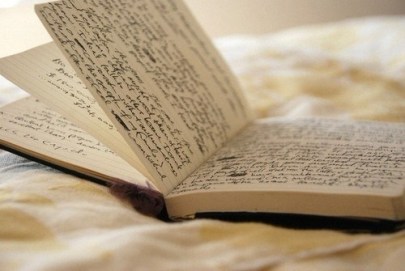
Notebook of Writing


It’s a grey Monday, and I’m ‘working at writing’ in a session with Amy Lyles Wilson, my editor. I say ‘my editor,’ because that sounds very official, doesn’t it? And she is my editor; she’s also a dear, trusted, and longstanding friend. The fact is, I’m not sure how a writer/editor relationship could work otherwise.

It’s a courageous thing, writing. As Hemingway says, ‘There’s nothing to writing; all you do is sit down at a typewriter and bleed.’ That’s the long and the short if it, right there.

The first draft of my book is finished. Yes, I deliberately “buried the lead” here. Because I’m not entirely sure how I feel about it. I’ll tell you this: it was with a weary, a relieved, and an ultimately dispassionate resolve that I finally finished that draft. And I’m a bit nervous about all the soul bearing stuff I wrote down in those 177 pages. I’d like to change my mind about some of it. But that would require a rewriting of my little piece of history. Truth lives on those pages, for better or for worse. Now, all I can do is breathe.

Writing is an excavation of the heart. When it’s about your own life, about how you got to here from there, it is a staunch enterprise. There are days — many — when you’re riddled with the thought that nobody could possibly be interested. Why would they care? Why am I doing this? But you continue on determined to, at the very least, finish what you started.

And so, you do. It might take twenty three years. You might, in 1995, get an official invite-to-submit from a major New York agent and knock yourself out writing enough to send her a sample. You might even get a letter back, saying she loves your work, that it feels “introductory,” and to please send more when your book is further along.

It’s March, 2018. That letter is in my file drawer. Wonder if she’s still interested.

The fact is, we all have stories. Amy’s slugline on her website is, “It’s the sharing of our stories that saves us.” And nothing could be more true. The funny stories, the heartbreaking stories, the stories that, when the readers read them, make their eyes well up or their hair catch fire … the hard stories.

The stories that don’t want to be written; the ones hiding in the shadows. THOSE are the stories we must write. And that’s what I’ve done.

There are more stories from different periods in my life that may need telling, if only for my children. Stories of my own childhood. Stories of my dreams, what they were, when some of them were abandoned, and why. For whom. And the resulting life that came after. The fact that, in this one lifetime, I’ve lived what could be classified as three distinct incarnations.

I’m in the third incarnation now, and closer to the end than I’ve ever been. With each passing day I pray, and wonder, and hope, and love. Even at this age, I feel the same creative passion and zest for life that I felt in my twenties. Those of you reading this who aren’t yet where I am, you’ll be here one day; you’ll think of this passage and realize the truth in what I’m saying to you now.

So yes, it’s a grey day of writing, and we’re here at this table, doing just that. I wouldn’t be here at all if I had no story to tell. The thing is, we all have stories inside us, wanting to be told. Let’s write them down. It may, indeed, be what saves us after all.


http://www.amylyleswilson.com


::MY ROOM::

still-life-with-lace-painting-mediumIt sat in the back corner of the house. There were two doors, one off the kitchen, and one into the boys’ bedroom.  The windows were on two sides, big and drafty. In the winter, Jack Frost made icy paintings on them. I loved it. Sometimes I would lick the ice, and watch it melt.

The wallpaper in my room was from Swinney’s hardware, my uncle John’s hardware store.

I loved that store. It had hardwood floors, front to back. There were wooden stairs to a catwalk that ran all the way around the at the second floor level. The walls up there were a checkerboard of colorful wallpaper samples. Lift the flap of paper, and the rolls of paper were stored in the cubbies behind.

My grandmother chose the wallpaper in my room. It was white, with loose bouquets of wildflowers tied with trailing blue ribbons. During the paper selection process, I was asked if didn’t I like this, or didn’t I think that was pretty. I loved looking at the samples, and leafing through the big wallpaper books. But I didn’t know what I liked. I was eight. I just wanted to make the adults in charge happy; I wanted whatever it was they wanted, because that makes everyone happy, right? Then I don’t get it wrong. That’s what you think when you’re eight.

Later, I would decide that my room looked old ladyish, I was silently disgruntled that my grandmother had picked it out … though even at ten or twelve, I didn’t know what I’d have chosen. Thinking back, I can see it was a sweet, cheery space in that stark little house. I wish I could see that paper now. I’d probably love it.

One of the things in my room was a wicker desk that had belonged to the mother of my other grandmother. My great grandmother. White wicker, with a wicker chair. That little desk has followed me all over the country, throughout my adult life. And it currently sits int eh bedroom at my house that is used by my granddaughters.

I wonder if it will some day be taken, and treasured, by my granddaughter, Gabby. There’s no way to know … but I hope so.

Meanwhile, thinking back, I love picturing that little white desk in my childhood bedroom; the wallpaper of flowers and the white dotted Swiss Priscillas. It’s where I laughed, cried, prayed, slept, and dreamed.

It was my room.

:: MISS HONEY ::

Miss Honey's House


Miss Honey seemed to love everyone. Her little house was surrounded by a picket fence, and the kitchen window faced the front. Perhaps that’s why the air around Miss Honey’s always smelled like fresh bread, sugar cookies, or apple pie.

Through the window at night, and in the early morning, you could see the kitchen light burning bright. And you could hear Miss Honey singing along with her Frank Sinatra records.

When the children walked home from school, they went out of their way to pass by Miss Honey’s. There were always tasty baked treats waiting for them in the wicker basket that hung on Miss Honey’s front gate.

During the Christmas Holidays, Miss Honey hung a fresh evergreen wreath on the front door, tied with a big red bow. Colored lights were swagged along the pickets, and a Christmas Cookiescandle shined in the kitchen window. The basket on the front gate filled up with decorated cookies: Santas, Christmas trees, bells, stockings, and gingerbread men.

Though everyone in town felt they knew her, people rarely saw Miss Honey. She was always calling “Heeelloooooo!” out the window or “Merry Christmaaaas!” as she swooped around the corner to the market or to church.

Miss Honey’s only child – if you could call him that – was a big orange cat named Carl. Carl was the size of a small dog, and acted like one some of the time.

When Carl wasn’t playing fetch with the school kids, he was parked on the welcome mat on Miss Honey’s front stoop. In the winter when it was snowy, Carl watched the lacy flakes come down from inside the kitchen window.

Miss Honey’s birthday was the first day of Spring. Every year, on her birthday, she baked cupcakes and used colorful frosting to create flowers on top of each one. She arranged Beautiful Cupcakesthem on a platter, and placed it on a little table underneath the basket on the gate. She watched through the kitchen window with a twinkle as the school children ooh’d, aaah’d, and tore in to the delicious treats. “Happy Birthday to me,” she whispered happily.

One year, on the night before her birthday, the school children and the townspeople all visited Miss Honey’s gate. They quietly placed hundreds of bouquets of Spring flowers in the wicker basket, and on the ground in front.

On her birthday, when Miss Honey came out with the cupcakes, she saw the flowers. She sat the tray down, swatted Carl away, and opened the card peaking up out of the wicker Miss Honey's Flowersbasket. Inside it read,

“We love you too, Miss Honey. Signed, everyone.” 


::MYSTERIES OF MAMA::

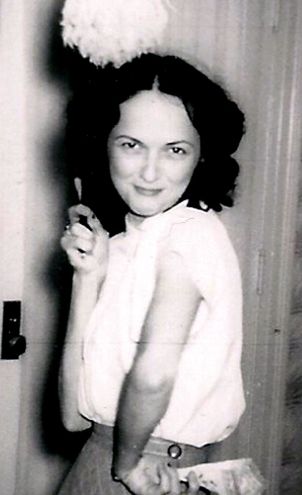
Mama, Close Up

This picture was taken when we lived on South Madison. In it Mama is her beautiful, comical, musical self. Back then she would strike a pose, then collapse in laughter. She had flair, a free spirit,  she was my personal movie star, even before I knew what movie stars were.

I’ve gone back and looked through as many events as I can remember, trying to piece things together.

I’m searching for the turning point. To find when things changed. When the sun stopped shining, and the world went from bright colors to shades of grey.

I remember we had moved to the little house on North Marion. The one with the crayon blue linoleum floor. I remember a pivotal darkness, but nothing will speak to me from there. I try to go inside that space, but it’s always …. like the memories in it are right on the tip of my brain. I can almost see them. But not enough to grab hold, and to understand.

The things I know are that they had friends back then. At night they would get dressed up and go out together, and leave me with Ma Welp. But what else was happening?
I remember kitchen cabinets, with the doors open. Mama’s friend was rearranging. I remember Mama crying, and putting things back in the right places after the friend left. It was during that time that she stopped laughing.

I remember the priest coming. I remember feeling confused, and then it fades to black.
After whatever happened, that friend who was changing Mama’s kitchen never came over anymore.

Years later, when she was into her cups and in the mood to offer sage advice, she would say that you should never let anyone into your life because they’ll just walk in like they own the place and take over everything. Never get too close to anyone, she said. That’s the only way you can be safe, she said.

I’ve always wondered if that was the philosophy she used through the years to stay so far away from me. We’re closer now than ever before because, at 92, she has no clue who I am. It is a brokenhearted comfort that she always says she’d “love to get to know you.” I’d like to get to know you too, Mama. Or at least to understand what happened that kept us separate. But whatever it was, I loved you so; I choose to know that you loved me.I’m reminded of Birdie’s mother saying,

“All mothers love their daughters, even if they show it poorly.”

::THE GANG’S ALL HERE::

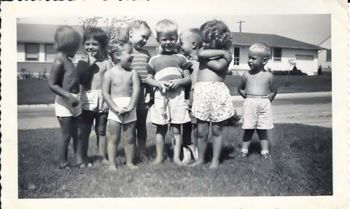
Celia and her buddies

If three year olds can be gang members, I was one. We had a pack of kids in our neighborhood on North Marion Street. Each morning, as early as any parent would allow, a youngster  drifted out the front door of his little clapboard house, and stood in the yard wearing nothing but a pair of rumpled camp shorts. Maybe he’d wander the length of  the driveway, bend down, pick up a rock, survey the street for signs of life, and head back to sit on his porch stoop. And wait.

Almost immediately, sets of young eyes threw quick glances out picture windows. Front doors opened, and small, tan feet ran or skipped or sauntered to assemble where the child was planted.

Thinking back, it gives new meaning to “the gang’s all here.” But we were.  The men in our gang wore shorts; the women, bloomers. We were brown as biscuits, the soles of our feet  well seasoned from weeks of running around bare.

We played all day, moving in a raggedy clump from one yard to another. Bill’s dad had left the hosepipe hooked up on the front spigot, so we all ran over because Shorty and Margo were thirsty. Mitchell and Bobby turned the handle, and the water spurted out. It went quickly from hot as fire to so clear and cold that suddenly we were all thirsty. Everybody got a chance. About eight or ten three year olds bending over spouting water, slurping it down their throats and bellies, all of us clamoring for more.

I don’t remember every name from back then, but I remember that water.  It started in Lake Spavinaw, and came pouring out of that front yard hose icy and sweet, flavored with a touch of rubber hose and a dash of brass metal. We all loved it, and kept drinking until Bill’s mother came out on the porch to shake the dustmop and caught us.

“You kids turn that water off and go play!” she hollered. She gave us the hard eye till Bill went over and cranked the handle.  By that time we were soaked, but we didn’t care. In fact, we liked it. It was 90 degrees in the Oklahoma shade, which there wasn’t much of.

Our gang lasted till we all started school, then life its own self took over and we drifted into our separate worlds. But if anyone ever asks me about gang membership, I can tell them, quite honestly, that I was a gang member very early on. And I’m proud of it.

::Right or Wrong::

right-or-wrong imageThe messages we’re given in childhood are powerful. Until we get out into the world on our own, they define our reality. They define our normal. They tell us what’s expected of us, and what value we have. And behind those front doors, each family has its own brand of ‘normal’.

I was raised in a house where there was one right way to do everything. Often I discovered there was a right way after I’d done something the wrong way. Mattered not if I accomplished my goal. If I didn’t do it the right way, I got it wrong. And that “right” way could change without warning; I learned that early on. So, go ahead, knock yourself out. But don’t count on anything except maybe being blindsided by a new rule, a new way of you failing again.

This is a piece of the legacy inherited by a child of alcoholics. Eventually, once we’ve reached adulthood and if we’re aware enough and brave enough to launch the quest for self discovery, we catch a glimpse of how life is defined outside the hazed cocoon in which we grew up; the only “normal” we’ve ever known. So there’s an overriding sense of betrayal, or having been lied to about ‘what’s going on out there’, ‘how I fit in the world,’ or even ‘who I am’. And, at its center, ‘what love feels like’.

That’s not to say that drinkers are evil. They’re not. I truly believe that very person, in one way or another, is ‘trying to find their way’. But some people get so off track; are so myopic as to what they’re doing and the damage caused by it, that they’re pretty much a walking (or stumbling) wrecking ball.

I’ll admit there are certainly things ingrained in me from my childhood that I treasure. I have a very well calibrated moral compass. I’m not an angel by any stretch, but when I’ve veered off course, I know it.

This comes from a Spiritually driven center that was awakened in me very early on. I clung to it, and was convinced that ‘if I’m good enough’ good things will, ultimately, happen. There’s probably a piece of me that still believes it.

In Seminary we studied addiction. It was pointed out to us that addicts are “headed the wrong way down the right road.” They crave a different feeling, a different perspective. But they’ve employed chemical shortcuts to get there, which always end in failure. Because in order to keep the feelings gained from drugs or alcohol, you have to stay drugged or drunk. The process is deeply and heartbreakingly flawed. Those same good feelings are authentically available. But like all things of true value, we gotta do the deliberate, serious (and personal) work to ‘get there from here’.

And something else I learned  in Seminary, is that there are quite possibly as many ways to do something as there are people to do it. Not right or wrong, based on approach. When I heard that it was not like a light went on in my head; it was more like a bomb went off.

For decades I held back on doing so many things, big and small, for fear I would do them wrong. It was earth changing when, after finally trying something, and doing it my way, there was no one there to tell me how wrong I was.

Maybe I was never really wrong, after all.

Blog at WordPress.com.

Up ↑